

Botox safety and risks depend on more than the injection itself. The product, your health history, the treatment area, and follow-up all matter. Temporary redness, swelling, bruising, tenderness, or headache can occur. Difficulty swallowing or breathing requires prompt medical attention.
Before deciding, get clear answers about how treatment relates to your health and goals. This is especially important if you take medication or have a health condition that could affect whether treatment is appropriate. This guide explains common side effects, warning signs that should not be ignored, and the information to share during a medical assessment. It also covers practical questions about product identity, treatment plans, and provider qualifications.
Organic Skin & Body Med Spa in Bradenton offers Botox and Dysport cosmetic injectables. The information below can help you prepare questions for an individual discussion with a qualified medical professional.
Key Takeaways
- Botox temporarily affects targeted muscle activity. Consider the intended cosmetic change alongside the possibility of future maintenance.
- Know which effects are commonly temporary and which symptoms may require prompt medical attention.
- Share your medications, supplements, allergies, pregnancy status, health conditions, and past treatment reactions during your medical assessment.
- Use these botox safety and risks questions to understand the product, treatment plan, and follow-up arrangements before deciding.
- Weigh your goals and personal circumstances without pressure or promises of guaranteed results.
Botox Safety and Risks: What the Treatment Does, and What Safety Means
Botox is a brand of botulinum toxin type A used cosmetically. When injected into selected muscles, it temporarily reduces the nerve signals that prompt those muscles to contract. As muscle activity decreases, certain expression lines may appear softer. The effect is temporary, and the degree and duration of change can vary. Botox does not permanently alter muscle activity or guarantee a particular cosmetic result.
What Botox does in cosmetic treatment
Cosmetic treatment targets specific muscles associated with expression lines. Botulinum toxin products are also used for certain medical purposes, but the treatment area, reason for use, and product instructions can differ. The Botulinum toxin overview describes the substance’s mechanism and range of uses. For an example of a cosmetic treatment area, see this guide to glabellar lines treatment.
Why risk depends on more than the injection itself
Safety depends on several factors: whether the product is authentic and handled appropriately, how your health history is assessed, the injection technique, and what follow-up is available if concerns arise. Risks can vary with the person, treatment area, dose, and health circumstances. General information can help you prepare, but only an individual medical assessment can address whether treatment is suitable for you.
Before treatment, discuss your medical history, any previous reactions to injections or similar products, and the intended treatment area. The same treatment can involve different considerations for people with different health circumstances. Ask which product is planned and how the proposed treatment relates to your goals and health information. These details help the treating professional assess potential risks and set realistic expectations.
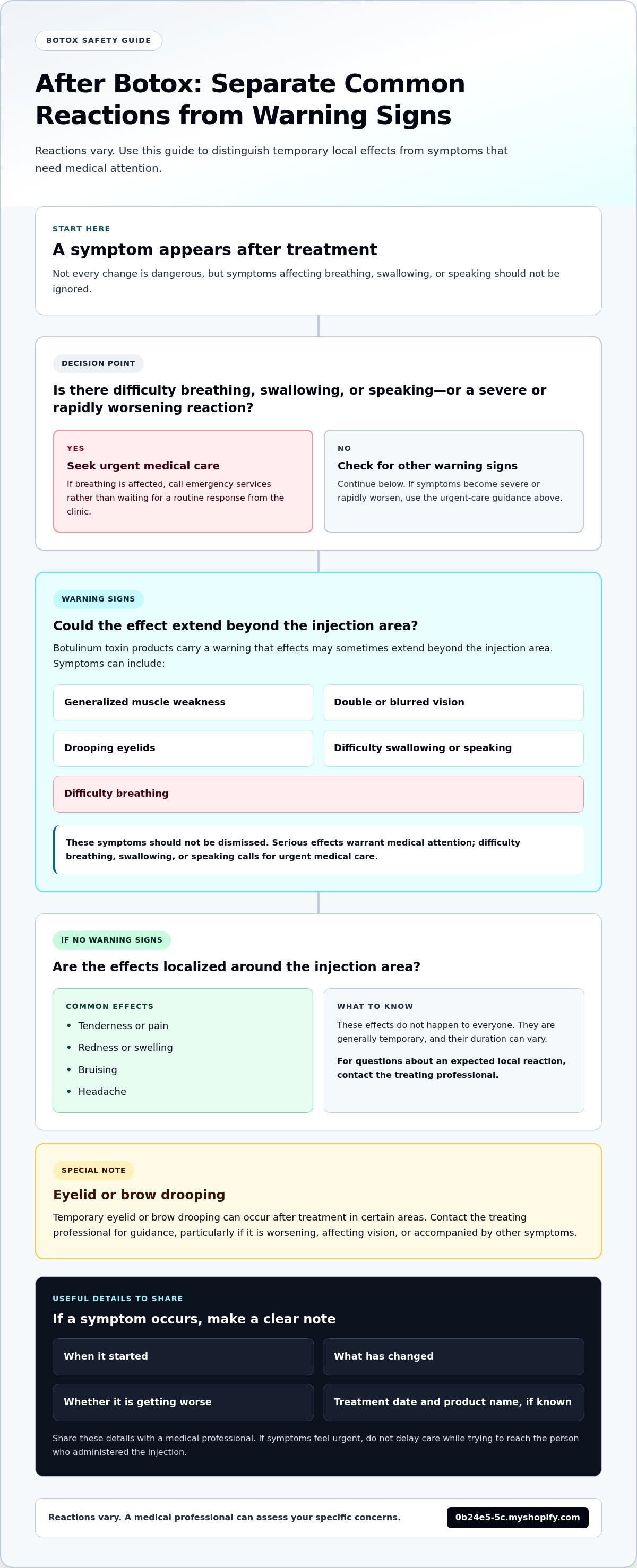
Common effects are generally temporary and limited to the injection area, while rare serious complications can involve symptoms such as difficulty swallowing or breathing. A temporary local reaction is not the same as a serious symptom that may need prompt medical attention. The next section explains common effects and warning signs to recognize.
For that reason, “Is Botox safe?” is not a complete personal assessment. A more useful question is how the product, treatment plan, health history, and follow-up apply to your circumstances. Reviewing botox safety and risks with a qualified medical professional can help clarify those factors before you decide. It also gives you an opportunity to discuss your cosmetic goals and concerns without treating a general safety summary as individualized medical advice.
Common Botox Side Effects and Rare Warning Signs to Recognize
Knowing what may happen after an injection can help you respond appropriately without assuming every change is dangerous. Reactions vary, and no list can predict exactly what one person will experience. For questions about a specific treatment, refer to the product’s official prescribing information and the guidance provided by your treating professional.
Common, usually temporary effects
Some people experience tenderness or pain, redness, swelling, or bruising around the injection area. A headache may also occur. These effects do not happen to everyone, and their duration can vary. Mild, localized discomfort is different from symptoms that affect breathing, swallowing, or speaking.
Temporary eyelid or brow drooping can also occur after treatment in certain areas. If you notice a change, contact the treating professional for guidance, particularly if it is worsening, affecting vision, or accompanied by other symptoms. Do not assume a symptom is harmless simply because it began near the injection site.
Rare symptoms that need prompt attention
Botulinum toxin products carry a warning that effects may sometimes extend beyond the injection area. Symptoms can include generalized muscle weakness, double or blurred vision, drooping eyelids, difficulty swallowing or speaking, and difficulty breathing. The Mayo Clinic on Botox Risks and Side Effects also explains that serious effects warrant medical attention.
Localized soreness, redness, swelling, or bruising may be temporary. Difficulty breathing, swallowing, or speaking is an urgent warning sign. Seek urgent medical care for these symptoms, or for any severe or rapidly worsening reaction. If breathing is affected, call emergency services rather than waiting for a routine response from the clinic.
If a symptom occurs, note when it started, what has changed, and whether it is getting worse. Share that information with a medical professional, along with the treatment date and product name if you know it. If symptoms feel urgent, do not delay care while trying to reach the person who administered the injection.
For questions about an expected local reaction, contact the treating professional. Urgent symptoms need medical evaluation. Understanding this distinction is a practical part of botox safety and risks: do not dismiss possible complications, but do not assume every mild effect is an emergency. A conversation about Botox and Dysport cosmetic injectables can include potential side effects and what steps to take if concerns arise.
Who May Face Added Botox Risks, and Which Claims Deserve Caution?
No single detail, such as age, a medication, or a past reaction, determines whether Botox is suitable. A clinician needs to consider your full medical history, the planned treatment area, and the product’s prescribing information. An online checklist can help you prepare, but it cannot replace an individualized medical assessment.
Health history and medicines to discuss beforehand
Before treatment, disclose neuromuscular conditions, allergies, previous reactions to botulinum toxin products, and any condition affecting the intended treatment area. Share whether you are pregnant or could be pregnant, and provide a complete list of prescription medicines, over-the-counter products, and supplements. Some medicines may affect neuromuscular function or interact with treatment. Do not stop or change a medicine on your own. Let the treating professional assess the details.
Be specific. If you had a previous reaction, mention when it occurred, what symptoms you noticed, and which product was used, if you know. Also raise any recent or planned procedures in the same area. The clinician can compare this information with the product’s current label and decide whether treatment should proceed, be modified, or be deferred. One health factor alone does not establish that treatment is automatically safe or unsafe.
How to interpret safety claims and product differences
Botulinum toxin products can differ in formulation, labeling, and dosing. FDA prescribing information states that potency units are specific to each product and are not interchangeable with units of other botulinum toxin preparations. A unit count or dose for one product should not be treated as a direct equivalent for another. Ask which product is planned and how its labeling applies to your proposed treatment.
Product authenticity and proper handling matter, too. Be cautious of offers that do not clearly identify the product or rely on absolute claims. “Risk-free,” “permanent,” and “safe for everyone” are not balanced descriptions of a medical treatment. A sound safety discussion should make room for individual screening, uncertainty, and possible side effects without using fear to pressure a decision.
The table below compares common claims with more careful ways to assess them. Use it to identify questions that deserve a clear explanation during a consultation.
| Claim or misconception | Careful, source-checked explanation |
|---|---|
| “Botox is safe for everyone.” | Suitability depends on medical history, allergies, prior reactions, treatment area, and product labeling. |
| “Units are the same across brands.” | Units are product-specific and are not interchangeable. Dosing must follow the relevant product information. |
| “The result is permanent.” | Cosmetic effects are temporary. The timing and degree of change vary by person and treatment details. |
| “Any vial or discount offer is equivalent.” | Product identity, authenticity, and handling should be clear. Vague claims do not establish product quality. |
These distinctions are central to understanding botox safety and risks. If a claim leaves out the product, your medical context, or the limits of what treatment can promise, ask for a clear explanation before deciding.
How to Prepare for Botox and Reduce Avoidable Safety Risks
Preparation gives you and the treating professional a clearer basis for discussing whether Botox fits your goals and circumstances. Bring accurate information, raise questions before treatment, and understand how to follow up. These steps can support an informed decision, but they cannot eliminate every possible risk.
Consultation checklist
- Summarize your health history. Note relevant conditions, allergies, pregnancy or possible pregnancy, and any previous reaction to cosmetic injections or botulinum toxin products.
- List everything you take. Include prescription and over-the-counter medicines, vitamins, and supplements. Do not stop or change anything unless the professional responsible for your care advises you to.
- Describe your goals. Identify the area you want treated and the change you hope to see. Ask what outcome is realistic and what limitations may apply.
- Clarify the treatment plan. Ask which product is planned, which area will be treated, and how the proposed plan relates to your goals and health information.
- Plan for follow-up. Ask whom to contact about non-urgent concerns, how to report an unexpected effect, and which symptoms require urgent medical care.
Clear answers matter. If you do not understand a product name, treatment area, or part of the plan, ask for an explanation before proceeding. Knowing which product is being used helps you distinguish its instructions from general advice about other products. The treating professional also needs the information required to consider your medical history and factors that may affect the decision.
Aftercare, follow-up, and when to seek help
After treatment, follow the specific instructions provided by the treating professional. Generic online advice may not match your product or individual plan. If you are unsure how an instruction applies, seek clarification rather than substituting a routine you found elsewhere. Keep any written guidance so you can refer to it later.
If an unexpected effect occurs, note when it began and how it changes, then report it according to the follow-up plan. Do not try to diagnose the cause or alter prescribed medication on your own. For severe or rapidly worsening symptoms, including difficulty breathing, swallowing, or speaking, seek urgent medical care rather than waiting for routine follow-up.
Good preparation does not mean assuming treatment is right for everyone. It means making room for a direct conversation about your priorities, questions, and the botox safety and risks relevant to your circumstances. For a local overview of cosmetic injectables, explore injectable treatments in Bradenton and consider what you want to discuss before making a decision.
Making an Informed Botox Decision in Bradenton, Florida
A sound decision weighs the cosmetic change you want against possible side effects, treatment limits, and the likelihood that results will need maintenance. You should have enough time and information to understand the plan, consider your circumstances, and decide whether the potential benefits make sense for you.
A simple decision checklist before choosing treatment
Before moving forward, consider whether you can answer these questions clearly:
- What outcome am I seeking? Describe the area and change you have in mind. Discuss what results are realistic rather than guaranteed.
- What are the limitations? Understand that results are temporary, can vary, and may require future treatments to maintain.
- What are the material risks? Make sure common effects and serious warning signs have been explained in language you understand.
- Have my circumstances been discussed? Share relevant health history, medicines, supplements, allergies, previous reactions, and other concerns before treatment.
- Do I understand the plan? Know which product and treatment area are proposed, what follow-up may involve, and whom to approach with questions.
If you cannot answer one of these questions, pause and ask for clarification. A decision framework should help you assess your priorities, not push you toward a particular choice. This overview of spas in Bradenton also offers local context.
What a transparent next step should provide
A useful treatment discussion makes room for your goals and concerns. It should address the proposed product, expected outcomes, possible risks, and individual details that may affect the plan. You should be able to ask questions and take time to consider the answers. Be cautious of pressure to proceed or promises that a particular result is certain.
Organic Skin & Body Med Spa is located in Bradenton, Florida, and offers Botox and Dysport cosmetic injectables. The decision to pursue treatment should follow an individualized discussion of your goals, health circumstances, and possible drawbacks.
Understanding botox safety and risks means weighing the information against what matters to you, including temporary results and the possibility of side effects. To learn more about the available options, explore Botox and Dysport services. Use this information to guide a conversation, not as a substitute for an individual medical assessment.
Take Your Next Step With Confidence
Your decision does not need to happen on the spot. If questions remain, write them down and use them to guide a conversation about your goals, health circumstances, and comfort with possible outcomes. A clear discussion can help you decide whether treatment fits your priorities now or whether waiting is the better choice.
Understanding botox safety and risks is part of making that decision, not a reason to feel pressured toward or away from treatment. Give yourself time to consider the information and seek clarification when something is uncertain.
Organic Skin & Body Med Spa in Bradenton offers Botox and Dysport cosmetic injectables. Explore Botox and Dysport services in Bradenton and bring your questions and personal goals to the conversation.
Frequently Asked Questions
Is Botox safe for most people?
Botox is used in cosmetic treatment, but it is not risk-free or suitable for every person. A botox safety and risks discussion should account for your health history, the area being treated, the specific product, and your goals. A qualified medical professional can review those details with you. Before deciding, make sure you understand realistic outcomes, possible effects, and which symptoms call for urgent medical care.
What are the most common side effects of Botox?
Possible side effects include pain, redness, swelling, or bruising where the injections were given, as well as headache. Temporary eyelid or brow changes may occur depending on the treatment area. These effects do not happen to everyone, and their duration can vary. Follow the instructions provided for your treatment. If a reaction is unexpected, worsening, or interfering with daily activities, report it to the treating professional rather than relying on an online description to judge its cause.
Can Botox cause serious complications?
Serious complications are uncommon, but current product information warns that toxin effects may extend beyond the injection area. Warning symptoms can include muscle weakness, vision changes, or difficulty swallowing, speaking, or breathing. Symptoms alone do not establish a diagnosis, but breathing, swallowing, or speaking difficulty needs urgent medical attention. Do not wait for a scheduled follow-up if these symptoms occur. Share the treatment and product details with medical professionals if you have them.
Who should avoid Botox or discuss it carefully first?
No single factor determines suitability for everyone. Discuss treatment carefully if you have a neuromuscular condition, an allergy, a prior reaction to an injection, or a concern involving the area to be treated. Tell the treating professional if you are pregnant, breastfeeding, or could be pregnant so they can consider your circumstances and the product information. Share your health history rather than relying on a general online rule to decide whether you should proceed.
Can Botox interact with medications or supplements?
Some medicines and supplements may be relevant to treatment planning, so provide a current list that includes prescriptions, nonprescription products, vitamins, and supplements. Mention recent changes and medicines you take only occasionally. The treating professional can review product-specific cautions alongside your health history. Do not stop, start, or adjust a prescribed medicine to prepare for injections unless the professional responsible for your care tells you to do so.
What happens if Botox causes trouble breathing or swallowing?
Seek emergency medical care immediately. Difficulty breathing or swallowing after treatment can be an urgent warning sign. Do not wait for a routine appointment or a reply to a non-urgent message, and do not try to manage these symptoms at home or use an online article to assess the cause. If you can do so without delaying care, tell medical professionals when the treatment occurred and which product was administered.
How can I reduce the risks before getting Botox?
Prepare a written record of your health conditions, allergies, medicines, supplements, and previous injection reactions, then review it before treatment. Ask which product is planned, what area will be treated, what outcome is realistic, and what to do if an unexpected effect occurs. Make sure you understand the individualized instructions and follow-up plan. These steps support informed care, but they cannot guarantee a particular result or remove every possible risk.