

Selecting the most famous brand name for your aesthetic treatment might actually be the wrong choice for your specific facial anatomy. It's common to feel uncertain when comparing dysport vs botox, particularly regarding complex dosing ratios or the fear of losing natural expression. You aren't alone if you're confused. Many patients wonder why one product requires more units than the other to achieve the same result or how long the effects will last in the humid Florida climate.
This professional comparison provides a technical breakdown of how these neuromodulators function so you can make an informed decision for your next appointment. We'll examine the protein structures that dictate formula spread, the 2026 FDA-approved applications, and the specific clinical benefits of each injectable. You'll learn why the 3 to 1 unit conversion ratio exists and how Dysport's faster onset of two to three days compares to the concentrated precision of Botox. By understanding these professional nuances, you can achieve smoother skin while maintaining the facial mobility you desire.
Key Takeaways
- Learn how these neuromodulators function at a cellular level to temporarily inhibit nerve signals and smooth skin.
- Understand the technical nuances of dysport vs botox, specifically how molecular size determines whether a product spreads or stays concentrated.
- Identify the differences in onset times, including which injectable typically shows visible results within two to three days.
- Determine which formula is better suited for specific facial areas, such as the forehead or the delicate skin around the eyes.
- Discover how a professional consultation at our Bradenton facility ensures a customized approach for your aesthetic goals.
Understanding Neuromodulators: The Science of Botox and Dysport
Neuromodulators represent a specialized class of injectable proteins. These substances are derived from botulinum toxin type A and serve as the foundation for modern non-surgical facial rejuvenation. Their primary function involves the temporary inhibition of nerve signals directed at specific facial muscles. When these muscles relax, the overlying skin can finally smooth out. This mechanism is particularly effective against dynamic wrinkles, which are lines caused by repetitive expressions like squinting or frowning. Both leading brands are FDA-approved for treating glabellar lines, commonly known as frown lines. When discussing dysport vs botox, it's essential to recognize that both are safe and effective when administered by professionals. Achieving a refreshed look requires a deep understanding of how these proteins interact with your unique physiology.
The Role of Botulinum Toxin Type A
The biological process centers on the neuromuscular junction. The toxin prevents the release of acetylcholine, which is the neurotransmitter that triggers muscle contraction. For those interested in the chemical specifics, The Science of Botulinum Toxin provides a comprehensive overview of these interactions. These procedures are non-surgical. Although the active ingredient is similar, the molecular weight of the surrounding proteins differs. This weight affects how the product diffuses through the tissue after the initial injection.
Cosmetic vs. Therapeutic Applications
Comparing the Formulations: Molecular Spread and Precision
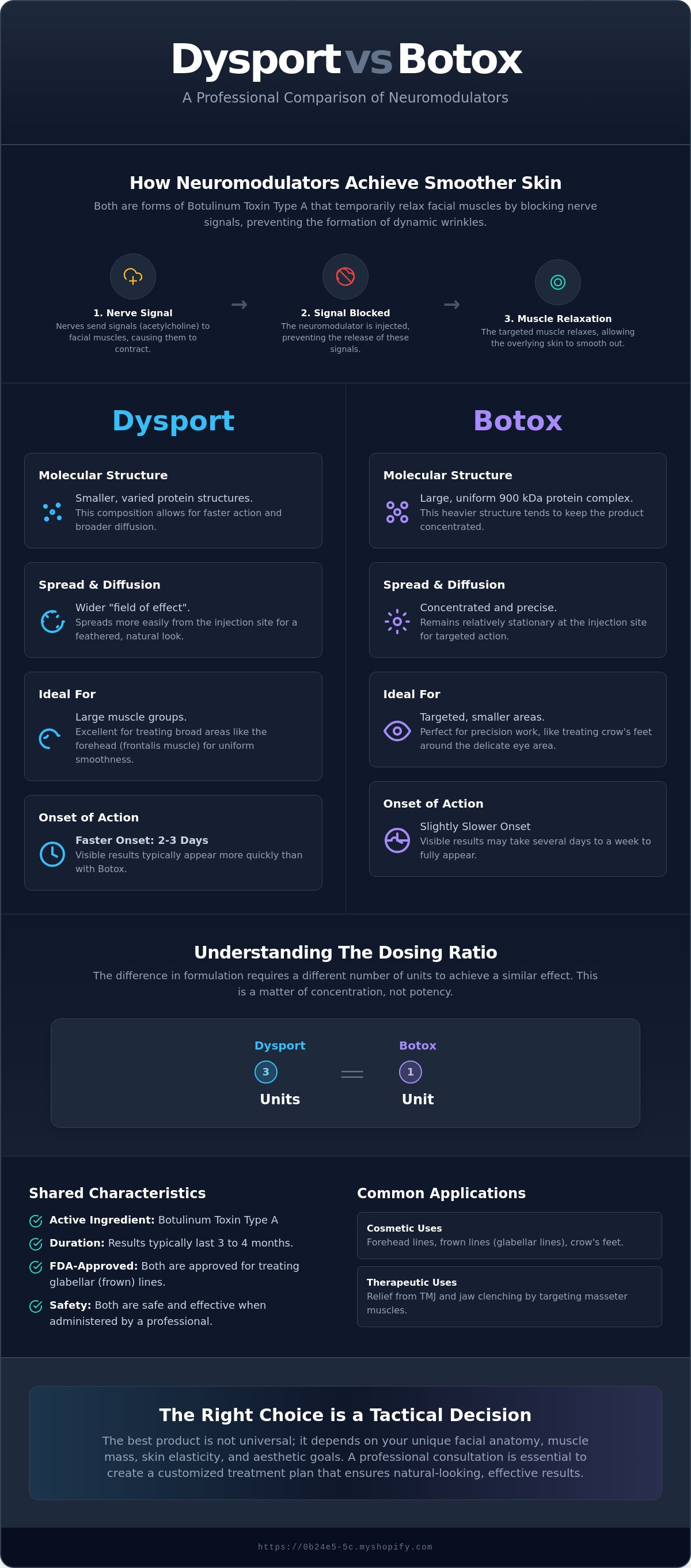
The primary technical difference between these two neuromodulators is rooted in their molecular composition. Botox consists of a large, uniform 900 kDa protein complex. In contrast, Dysport contains smaller, more varied protein structures. This physical property directly impacts how the solution behaves once injected into the muscle tissue. While Botox remains relatively stationary at the injection site, Dysport is designed for a broader distribution. This characteristic is often the deciding factor in the dysport vs botox debate for specific anatomical regions. Practitioners select the product based on whether the goal is a localized freeze or a broader softening of muscle movement. Understanding these molecular nuances is essential for achieving a result that looks both effective and natural.
Dosing also reflects these formulation differences. Because the concentration of active toxin varies, clinicians don't use a one-to-one ratio when switching between brands. Usually, one unit of Botox is equivalent to approximately three units of Dysport. This isn't a reflection of potency but rather a requirement of the specific liquid suspension. Choosing the right formulation requires an expert assessment of your muscle mass and skin elasticity. If you're ready to explore these options, consider a professional cosmetic injectable consultation to determine which product aligns with your goals.
The Diffusion Factor in Dysport
A wider spread is highly advantageous when treating expansive muscle groups. For instance, the frontalis muscle in the forehead is quite large. Using a product with a higher "field of effect" allows for a smoother, more uniform relaxation across the entire brow. This diffusion creates a natural appearance by preventing sharp, visible boundaries between treated and untreated muscle fibers. According to a Clinical Comparison of Dysport and Botox, this spread is a defining feature that distinguishes the two products in clinical settings. It ensures that the transition between muscle groups is subtle, which helps avoid the unnatural look some patients fear.
Precision Targeting with Botox
Botox is formulated to stay exactly where it's placed. This high degree of localization is essential for delicate areas where affecting nearby muscles could lead to unwanted side effects. Practitioners typically prefer this precision for crow's feet around the eyes or for treating specific fine lines near the mouth. The goal in these zones is to isolate the target muscle without compromising the function of adjacent muscle groups. This localized action makes it the gold standard for patients who need very specific corrections in small, high-stakes areas of the face. In the dysport vs botox comparison, Botox remains the preferred choice for surgical precision in a non-surgical format.
Onset, Duration, and Dosing: What to Expect
Patients often prioritize speed when choosing between dysport vs botox. If you have an upcoming event, the timeline of results becomes a critical factor in your decision process. Dysport is frequently noted for a faster onset of results, with many individuals observing initial muscle relaxation within two to three days. Botox results typically become visible within five to seven days, though the exact timing depends on the specific injection site and your unique physiology. Regardless of which product you select, both formulas offer a similar duration of effect. In a standard clinical setting, results generally persist for three to four months before muscle activity gradually returns to its baseline state.
Understanding the value of your treatment requires looking beyond the number of units. Because these products utilize different protein concentrations, dosing is not equivalent. Typically, three units of Dysport are required to match the clinical effect of a single unit of Botox. This 3:1 ratio is a standard pharmaceutical conversion and doesn't imply that one product is superior or more "diluted" than the other. Professional providers at our Bradenton facility calculate these requirements based on muscle strength and the depth of the wrinkles being treated. This ensures a truly customized treatment plan that addresses your specific aesthetic goals without the risk of over-treatment.
Timeline of Results
Monitoring your progress involves a specific day-by-day progression. While you might notice early changes, we consider the two-week mark the official benchmark for success. This 14-day window allows the neuromodulator to fully bind to the neuromuscular junction. Factors that influence this timeline include:
- Individual Metabolism: Patients with higher metabolic rates may process the protein faster, potentially affecting both onset and longevity.
- Muscle Mass: Stronger muscles, such as those in the jaw or glabella, may require more time to fully relax.
- Injection Precision: Accurate placement ensures the toxin reaches the target receptors efficiently.
Don't judge your final look by the results seen on day four. Waiting the full two weeks prevents unnecessary touch-ups and ensures the skin has settled into its new, smoother position.
The 3:1 Dosing Ratio Explained
A common misconception is that receiving more units of Dysport results in a "stronger" dose. In reality, 60 units of Dysport provide approximately the same muscle-relaxing power as 20 units of Botox. When comparing dysport vs botox, it's more functional to view pricing and efficacy by the treatment area rather than the individual unit. Your provider will assess the tension in your facial muscles to determine the exact volume needed for a natural look. This technical approach avoids the "frozen" appearance while ensuring the treatment lasts the expected three to four months. By focusing on the desired outcome, you can choose the injectable that best suits your timeline and anatomical needs.
Choosing the Right Treatment for Your Skin Goals
Selecting the appropriate product in the dysport vs botox comparison requires a tactical evaluation of your specific facial anatomy. Forehead lines often benefit from the spreading characteristics of Dysport. Its ability to diffuse across larger muscle groups allows for a softer, more uniform result in the upper face. Conversely, crows feet and fine lines around the eyes typically require the precision of Botox. Because the skin near the eyes is delicate, localized action is necessary to prevent the product from affecting nearby muscles. If you want a tailored plan, book a professional consultation for cosmetic injectables to discuss your options.
Individual skin thickness and muscle activity levels dictate the final recommendation. A patient with high muscle density may require higher dosing or a specific brand to achieve the desired relaxation. Modern aesthetics often involve a "global" approach, which focuses on the entire face rather than isolated wrinkles. This strategy combines injectables with skin rejuvenation techniques to provide a balanced and refreshed appearance. It's not just about freezing a single line; it's about harmonizing your facial features.
Mapping Your Facial Anatomy
A provider assesses muscle pull and skin laxity during a formal consultation. This process involves observing your face in motion to determine how your muscles interact. Some patients may actually benefit from using both products in different areas. For instance, a clinician might use Dysport to smooth a wide forehead and Botox to target precise lines around the mouth. Maintaining facial mobility is a priority for a professional result. The objective is to reduce dynamic wrinkles while preserving the ability to express emotion naturally. Precise mapping ensures that the treatment supports your natural expressions rather than masking them.
Synergy with Advanced Treatments
Injectables work best when the underlying skin is healthy and resilient. Treatments like Morpheus8 can enhance the results of neuromodulators by improving skin texture and stimulating collagen production. While the neuromodulator relaxes the muscle, the RF microneedling addresses surface-level laxity. Additionally, professional organic facials are vital for maintaining skin health between your scheduled injections. This "tweakment" philosophy emphasizes small, regular adjustments. These consistent efforts lead to better long-term maintenance and prevent the need for more invasive procedures in the future. Small, strategic interventions often yield the most natural and sustainable results.
Professional Aesthetic Consultations in Bradenton, FL
Organic Skin & Body Med Spa provides a formal, clinical environment for all aesthetic procedures. Our Bradenton facility serves clients from Sarasota, Lakewood Ranch, and the surrounding regions with a focus on technical excellence. We prioritize a transparent process so that every client understands the specific nuances of their injectable journey. Florida residents face unique skin challenges due to high UV exposure, which often accelerates the breakdown of collagen and deepens dynamic wrinkles. Addressing these concerns requires a professional understanding of how dysport vs botox formulations respond to sun-damaged skin. Expert care is essential to ensure that your results remain natural and effective despite the intense local climate.
The Importance of a Local Med Spa
Choosing a local provider ensures that your treatment plan accounts for regional environmental factors. The convenience of visiting a spa in Bradenton, FL allows for the consistent maintenance required to sustain neuromodulator results. High heat and humidity can influence early post-treatment recovery, making local expertise invaluable. Building a long-term relationship with an aesthetician ensures your provider understands how your skin has changed over time due to seasonal sun exposure. Regular adjustments are more effective when your history is well-documented in a single, professional facility. It's easier to track your progress when you don't have to travel far for follow-up assessments.
Your First Appointment: What to Expect
The initial session begins with a comprehensive medical history review and a detailed treatment mapping process. We analyze your muscle pull and skin laxity to determine the ideal placement for each injection. The functional steps of the procedure are designed to ensure comfort and precision. After the injections, we provide specific post-care instructions that are essential for those living in the Florida heat. These instructions include:
- Strict sun avoidance for at least 24 hours to prevent localized inflammation.
- Maintaining high levels of hydration to support the skin's recovery process.
- Avoiding strenuous exercise that could increase blood flow to the face too quickly.
Understanding the differences in dysport vs botox during this initial phase helps you set realistic expectations for your three to four month results cycle. Our goal is to provide a stress-free environment where your aesthetic goals are met with clinical accuracy. By following a structured plan, you can maintain a refreshed appearance that withstands the Florida sun.
Achieving Your Ideal Aesthetic Result in 2026
Achieving the right balance between muscle relaxation and natural expression requires a technical understanding of the dysport vs botox comparison. You've learned that Dysport's molecular spread is advantageous for larger areas, while Botox offers the precision required for high-stakes zones like the eyes. A successful outcome in 2026 depends on accurate dosing and a professional assessment that accounts for your unique facial anatomy and the intense Florida sun. Professional guidance ensures that your results look refreshed rather than frozen.
Our Bradenton facility provides a formal, stress-free environment where expert providers specialize in both leading neuromodulators. We also offer comprehensive rejuvenation services, including Morpheus8 and HydraFacials, to support your skin's overall health and texture. Selecting the right injectable is a tactical decision best made with clinical expertise. Book Your Professional Injectable Consultation in Bradenton to receive a personalized treatment strategy. We're ready to help you achieve your aesthetic goals with precision and care.
Frequently Asked Questions
How long do the results of Botox vs. Dysport typically last?
Clinical results for both products generally persist for three to four months. Individual factors like your metabolic rate, the strength of your facial muscles, and your lifestyle can influence this duration. Once muscle activity gradually returns, you can schedule a maintenance appointment to sustain the smoothing effects. Consistency in treatment often leads to more predictable and sustainable results over time.
Does Dysport really show results faster than Botox?
Dysport typically demonstrates a faster onset of action, with many patients observing initial muscle relaxation within two to three days. In contrast, Botox results usually begin to appear within five to seven days after the procedure. Both products require a full 14 days to reach their peak clinical effect. This makes Dysport a frequent choice for individuals who have a more immediate timeline for an upcoming event.
Can I switch from Botox to Dysport if I have used one for years?
You can switch between these neuromodulators, provided your clinician adjusts the dosing correctly. Since the products aren't interchangeable on a one-to-one basis, your provider will calculate the appropriate units based on the technical 3:1 ratio. Many patients explore the dysport vs botox comparison to see if their body responds more favorably to one formulation over time. A professional consultation ensures the transition is seamless and effective.
Is one injectable more effective for deep forehead wrinkles?
Dysport is often preferred for the forehead because its smaller molecular structure allows for a wider spread across the large frontalis muscle. This diffusion can create a more uniform softening of deep horizontal lines. However, Botox is equally effective when placed precisely by an experienced injector. The final choice depends on the specific depth of your wrinkles and your desired level of brow mobility after the treatment.
What are the most common side effects of neuromodulators?
The most common side effects include localized swelling, minor bruising, or redness at the injection site. Some patients report a mild headache shortly after the treatment, which typically resolves within 24 to 48 hours. Rare but possible effects include temporary eyelid drooping if the product migrates. Following professional post-care instructions and avoiding the injection site for several hours significantly reduces the risk of these complications.
How many units will I need for my first treatment?
Dosing is highly individualized and depends on the specific treatment area and the product selected. For example, a standard forehead treatment might require 10 to 20 units of Botox or 30 to 60 units of Dysport. Your provider will evaluate your muscle strength and the severity of the lines during your initial mapping. We prioritize a conservative approach for first-time patients to ensure natural, expressive results.
Is there any downtime required after the injections?
There is no formal downtime required, and most patients return to their daily activities immediately. You should avoid lying flat, rubbing the injection site, or engaging in vigorous exercise for at least four hours following the procedure. These functional precautions prevent the neuromodulator from migrating to unintended muscles. Florida residents should also avoid direct heat and intense sun exposure on the day of their treatment.
Which is better for preventing future wrinkles from forming?
Both injectables are equally effective for preventative treatments, which aim to relax muscles before deep lines become etched into the skin. By starting early, you can significantly delay the onset of static wrinkles that are visible even when the face is at rest. When evaluating dysport vs botox for prevention, the decision usually rests on the specific anatomy of the target area. Proactive maintenance reduces the need for more intensive corrections later.