

What if the primary obstacle to clearing your skin isn't the ink itself, but the fear of what remains after it is gone? Many people in Bradenton hesitate to address unwanted tattoos because they worry that the process will result in keloid scarring or permanent skin discoloration. It is a valid concern. For years, older laser technologies often left the skin's texture compromised. However, achieving tattoo removal without scarring is now a standard clinical outcome when the right technology is paired with precise medical protocols.
You deserve a solution that restores your skin to its natural state without leaving a roadmap of where the ink used to be. This guide provides a transparent look at how advanced picosecond lasers and professional aftercare routines protect your skin's integrity in 2026. We will detail the specific differences between laser types, explain how to avoid texture changes, and outline the sequence of facts you need to know for a safe, professional experience. You will learn how modern clinical standards result in complete ink clearance and skin texture that matches the surrounding area.
Key Takeaways
- Learn why tattoo removal without scarring is the clinical standard in 2026, focusing on the restoration of natural skin pigment rather than just ink removal.
- Understand the Photo-Acoustic Effect used by modern picosecond lasers to shatter ink particles without causing thermal damage to the surrounding tissue.
- Identify the critical role of customized laser settings and why prioritizing skin safety over treatment speed is essential for avoiding permanent texture changes.
- Discover the mandatory pre-treatment and post-treatment protocols, including the strict four-week sun avoidance rule required for optimal healing.
- Explore the professional consultation process at Organic Skin & Body Med Spa to set realistic expectations for your specific skin type and tattoo complexity.
Can Tattoos Be Removed Without Scarring? Modern Realities in 2026
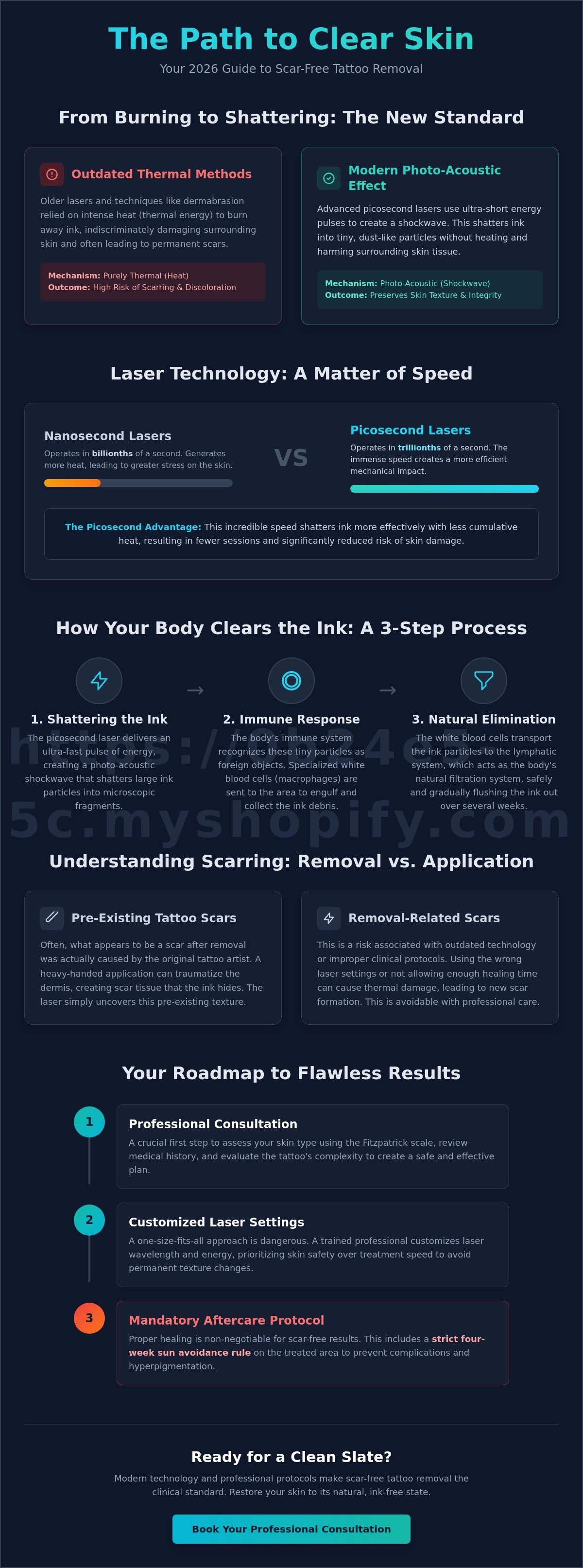
The clinical standard for successful tattoo clearance has shifted. In the past, removing ink often came at the expense of skin texture. Today, achieving tattoo removal without scarring means more than just making the ink disappear; it requires the full restoration of natural skin pigment and smoothness. Many patients still believe that lasers work by burning the skin to reach the ink. This is a misconception based on outdated technology. Modern clinical protocols utilize photo-acoustic energy rather than purely thermal energy. While older lasers relied on heat that could damage surrounding tissue, newer systems use ultra-short pulses to shatter ink particles into dust without boiling the skin.
Understanding these Modern Realities in 2026 requires a look at why historical methods failed. Techniques like dermabrasion or acid peels were physically invasive. They removed layers of the dermis indiscriminately, which almost guaranteed permanent textural changes. Modern laser technology is selective. It targets the ink while leaving the skin's structure intact. This precision allows the body to flush away the shattered ink through the lymphatic system while the surface remains undamaged.
The Difference Between Tattoo Scarring and Removal Scarring
It's vital to distinguish between a scar caused by the removal process and a scar caused by the initial tattooing. Many individuals discover a raised area or a "ghost" image once the ink clears. This is often the result of the original tattoo artist being heavy-handed or using a needle depth that caused trauma to the dermis. In these cases, the laser simply reveals the scar tissue that was already present under the pigment. You can often identify this early by feeling for raised textures on the tattoo before starting your sessions. If the skin is already raised, the laser will remove the color, but it won't necessarily flatten the existing scar tissue.
Who is a Candidate for Scar-Free Removal?
Success depends heavily on an individual's skin type and medical history. We use the Fitzpatrick scale to categorize skin tones and determine the appropriate laser wavelengths. For years, patients with darker skin tones faced a higher risk of hyperpigmentation. Modern technology has mitigated these risks by allowing for precise energy delivery that avoids over-stimulating melanin. Achieving tattoo removal without scarring is possible for most skin types, but the treatment plan must be customized. If you have a history of keloid scarring, the frequency and intensity of sessions must be adjusted. We assess these variables during the initial consultation to ensure the skin remains healthy throughout the clearance process.
The Science of Scar-Free Removal: How Advanced Lasers Protect Your Skin
The mechanics of tattoo removal without scarring have evolved from heat-based destruction to precise mechanical fragmentation. While historical methods relied on thermal energy to break down pigment, modern clinical lasers utilize the photo-acoustic effect. This process sends ultra-fast pulses of energy into the skin, creating a shockwave that shatters ink into dust-like particles. Because the energy is delivered in such short bursts, it doesn't have time to heat the surrounding skin cells to a dangerous level. This protects the dermal structure and significantly reduces the chance of permanent texture changes.
After the laser fragments the ink, the body's lymphatic system begins the clearance process. Specialized white blood cells move into the treated area to collect the microscopic debris. These cells carry the ink particles through the lymph nodes, where they are eventually filtered out of the body. Successful clearance depends on this natural biological response. Proper hydration and healthy circulation support this phase, ensuring that the skin remains healthy throughout the treatment cycle.
Nanosecond vs. Picosecond Technology
Older nanosecond lasers operate in billionths of a second. While effective for some ink types, they generate substantial heat that can lead to blistering or long-term pigment loss. In contrast, picosecond lasers operate in trillionths of a second. This speed creates a photomechanical impact that is more efficient at breaking down stubborn colors with less cumulative stress on the skin. Using advanced technology often means you need fewer sessions to achieve complete clearance, which further lowers the risk of skin fatigue.
Wavelength Accuracy and Pigment Targeting
Preserving skin integrity requires matching the laser wavelength to the specific color of the ink. For example, a 1064nm wavelength is ideal for black ink on most skin types, while a 532nm wavelength targets red and orange pigments. When the wavelength is accurate, the energy is absorbed only by the ink, leaving the surrounding skin cells untouched. Spot size also plays a role; larger spot sizes allow the laser to penetrate deeper into the dermis without increasing surface intensity, which prevents superficial burns. When Evaluating the Risks: Why Some Removals Scar, it's clear that precision is the most important factor. If you're ready to start your journey, exploring professional laser removal services can help you determine the best wavelength for your specific tattoo.
Evaluating the Risks: Why Some Removals Scar While Others Do Not
The success of your treatment depends as much on the operator as it does on the technology. While picosecond lasers provide the mechanical means for tattoo removal without scarring, the "Technician Factor" remains the most critical variable. Every session requires a dynamic adjustment of laser settings, including fluence, spot size, and frequency. As the ink fades and moves deeper into the dermis, the technician must recalibrate the energy levels to ensure the laser continues to fragment pigment without over-taxing the surrounding tissue. If a provider uses the same aggressive settings for every session, the risk of thermal buildup increases, which can lead to permanent changes in skin texture.
Aggressive treatments that prioritize speed over safety are a primary cause of complications. Some providers might attempt "stacking," which involves firing multiple laser pulses on the exact same coordinate during a single pass. This technique significantly increases the heat in the dermis and can lead to immediate tissue damage. Your immune system also plays a vital role in this process. Because the lymphatic system is responsible for carrying away shattered ink particles, your overall health impacts how quickly the skin heals. If the body is under stress, the inflammatory response may last longer than intended, increasing the window for potential scarring.
The Danger of Over-Treatment
Patience is a clinical necessity. We recommend waiting 8 to 12 weeks between sessions to allow the skin to fully recover and the lymphatic system to clear the fragmented ink. Rushing this timeline doesn't speed up the removal; it only increases the cumulative stress on the skin. During a session, you will notice a "frosting" effect, which is a white gas bubble that forms on the skin's surface. This is a normal reaction to the laser's impact, but it must be monitored closely by a professional to ensure the energy hasn't penetrated too deeply. Avoid any "guaranteed" fast removal claims, as these often involve unsafe energy levels that risk your skin's long-term health.
The Role of Infection in Scarring
Your Roadmap to Smooth Skin: Pre- and Post-Treatment Protocols
Clinical excellence in the treatment room must be matched by disciplined care at home. Achieving tattoo removal without scarring is a collaborative process where your daily habits determine the final texture of your skin. Because the laser creates a controlled internal response, your body requires specific conditions to process the ink and repair the dermal layers efficiently. This roadmap ensures your skin remains resilient throughout the entire clearance cycle.
Pre-Care: Preparing the Dermis for Success
Preparing the skin begins at least one month before your appointment. You must adhere to a strict four-week sun avoidance rule. In Florida, this requires more than just sunscreen; you must physically cover the treatment area whenever you are outdoors. UV exposure increases melanin production, which interferes with the laser's ability to target ink and significantly increases the risk of hyperpigmentation or burns. This rule applies to artificial tans and bronzing creams as well. We also recommend daily supplementation of Vitamins C and E to support immune function and collagen synthesis. Proper hydration is equally vital. Aim for high water intake to ensure your lymphatic system is primed to transport shattered ink particles as discussed in previous sections.
Post-Care: The Critical 72-Hour Window
The first 72 hours post-treatment are the most critical for preventing complications. You should clean the area twice daily with a mild, fragrance-free cleanser and apply a thin layer of protective ointment. Use a breathable bandage to protect the site from friction while allowing oxygen to reach the skin. During this window, you must follow the "No Heat" rule. Avoid hot tubs, saunas, and intense Bradenton humidity, as excessive heat can lead to localized swelling and blister formation. To soothe the area naturally, we recommend using Organic Skin Care solutions that contain non-irritating, plant-based ingredients. These topicals help manage inflammation without introducing harsh chemicals to the healing dermis.
Resuming normal activities requires a graduated approach. You should avoid vigorous exercise for 48 to 72 hours to prevent sweat from irritating the treatment site. Swimming in pools, lakes, or the ocean must be avoided until the skin has completely closed and any minor scabbing has naturally detached. This usually takes 7 to 10 days depending on your individual healing rate. If you're ready to commit to a professional recovery plan, you can schedule your laser removal services to begin your journey toward clear skin. Following these steps ensures that the removal process remains safe and effective from the first session to the last.
Professional Laser Tattoo Removal in Bradenton: The Organic Skin & Body Approach
Organic Skin & Body Med Spa serves as a clinical leader in corrective skin treatments for residents of Bradenton, Sarasota, and Lakewood Ranch. We recognize that tattoo removal without scarring is a complex biological process that requires more than just high-end equipment. Our facility integrates medical-grade laser technology with a steady, informative approach to patient care. By maintaining a professional med spa environment, we provide a structured setting where technical precision meets clinical safety. This ensures that every session is conducted under the highest standards of hygiene and anatomical expertise.
The local climate in Florida presents unique challenges for laser recovery. High UV indices and persistent humidity can complicate the healing process if not managed correctly. Our team understands these environmental factors and incorporates them into every treatment plan. We don't just focus on the ink; we focus on the long-term health of your skin. This regional expertise allows us to guide you through the specific sun-avoidance strategies and hydration needs essential for success in the Gulf Coast environment.
Why Choose a Med Spa Over a High-Volume Tattoo Shop?
The primary advantage of a med spa is the level of clinical oversight. At Organic Skin & Body, a medical director and licensed aestheticians supervise the removal process. This is a critical distinction from high-volume shops that may lack the medical training to handle complex skin reactions. If you have pre-existing texture issues from the original tattoo application, we can integrate Advanced Laser & RF Treatments to refine the skin surface after the ink is cleared. We invite you to experience a Bradenton Spa Center that prioritizes skin health and provides a transparent roadmap for your results.
Next Steps: Your Consultation at Our East State Road 70 Location
Your journey begins with a comprehensive assessment at our East State Road 70 location. During this consultation, we evaluate the age, depth, and color profile of your tattoo to establish a realistic timeline. We employ a customized "session spacing" philosophy, often recommending 8 to 12 weeks between treatments. This disciplined timing is essential for tattoo removal without scarring, as it allows the lymphatic system to clear debris without over-taxing the dermis. We will also review your medical history to ensure your immune system is prepared for the clearance process. When you are ready to achieve clear skin through a safe and professional experience, book your consultation today to receive your personalized treatment plan.
Your Path to Restored Skin in Bradenton
Achieving tattoo removal without scarring is a realistic objective when you combine advanced clinical tools with rigorous aftercare. You've seen how the transition from thermal to photo-acoustic energy protects your skin's texture. You also understand that your commitment to sun avoidance and hydration plays a decisive role in the final outcome. Success is not just about the laser; it's about a structured partnership between the technician and the patient.
Our facility provides the professional environment necessary for this transition. We utilize advanced picosecond technology under medical director oversight. Every session is performed by certified laser technicians who prioritize the long-term health of your dermis over rapid results. This methodical approach ensures that your skin remains smooth and pigment-free.
Don't let the fear of permanent marks prevent you from addressing an unwanted tattoo. Take the first step toward clear skin by speaking with a specialist who understands the science of dermal recovery. Schedule Your Free Tattoo Removal Consultation in Bradenton today. We look forward to helping you restore your skin to its natural state.
Frequently Asked Questions
Is it possible to remove a tattoo 100% without a scar?
Yes, achieving tattoo removal without scarring is the expected clinical outcome when using modern picosecond technology. Complete clearance is possible when the technician uses the correct wavelengths and the patient follows all aftercare protocols. If the original tattoo application caused deep tissue trauma, a "ghost" image of the pre-existing scar may remain even after all the ink is gone. The laser reveals what is already underneath the pigment.
How much does laser tattoo removal cost in Bradenton, Florida?
The cost of laser removal depends on the size, age, and ink complexity of your tattoo. Most providers determine pricing based on the total surface area and the estimated number of sessions required for full clearance. You should schedule a professional assessment to receive an accurate quote tailored to your specific skin needs. Factors such as ink density and the number of colors involved will influence the final treatment plan.
Does laser tattoo removal hurt more than getting the tattoo?
Most patients report that the sensation is similar to a quick snap of a rubber band against the skin. While the discomfort is comparable to the original tattooing process, laser sessions are significantly faster. A treatment that took hours to ink can often be lased in just a few minutes. We use various cooling techniques to manage sensitivity and ensure a professional experience throughout the procedure.
What happens if I get a blister after my laser removal session?
Small blisters are a common biological response to the laser's mechanical impact on the ink. If a blister forms, you must not pop or peel it, as this creates an open wound that increases the risk of infection and permanent marks. Keep the area clean and covered with a breathable bandage. Most blisters will flatten and heal naturally within 5 to 7 days as the skin underneath repairs itself.
Can I go to the beach in Sarasota after my tattoo removal treatment?
You should avoid the beach for at least four weeks after each session. Saltwater and sand introduce bacteria to the healing skin, while UV exposure is the primary cause of hyperpigmentation. In the Florida climate, you must keep the treated area physically covered with clothing or a medical bandage whenever you are outdoors. This ensures the skin heals correctly and remains clear of secondary pigment changes.
How many sessions will I need to see clear skin?
Complete removal typically requires an average of 6 to 10 sessions based on current 2026 clinical data. This timeline varies based on the ink's density and the location of the tattoo on your body. Tattoos located further from the heart, such as on the ankles or wrists, may take longer to clear. This is because the lymphatic system works more slowly in those areas to transport shattered ink particles away.
Are there any organic ways to speed up tattoo removal healing?
Supporting your immune system is the most effective way to facilitate healing. High water intake improves lymphatic flow, which helps the body transport shattered ink particles more efficiently. You can also use organic topicals with plant-based ingredients to soothe inflammation naturally. Maintaining a diet rich in antioxidants supports the skin's natural repair mechanisms without the use of harsh chemicals or synthetic irritants.
What is the best laser for removing tattoos on dark skin without scarring?
Picosecond lasers are currently the safest option for achieving tattoo removal without scarring on darker skin tones. These systems use ultra-short pulses that minimize heat buildup, which is the primary cause of pigment changes. Technicians typically use a 1064nm wavelength for darker skin because it effectively targets black ink while bypassing the melanin in the surrounding tissue. This precision prevents both hyperpigmentation and textural changes.