

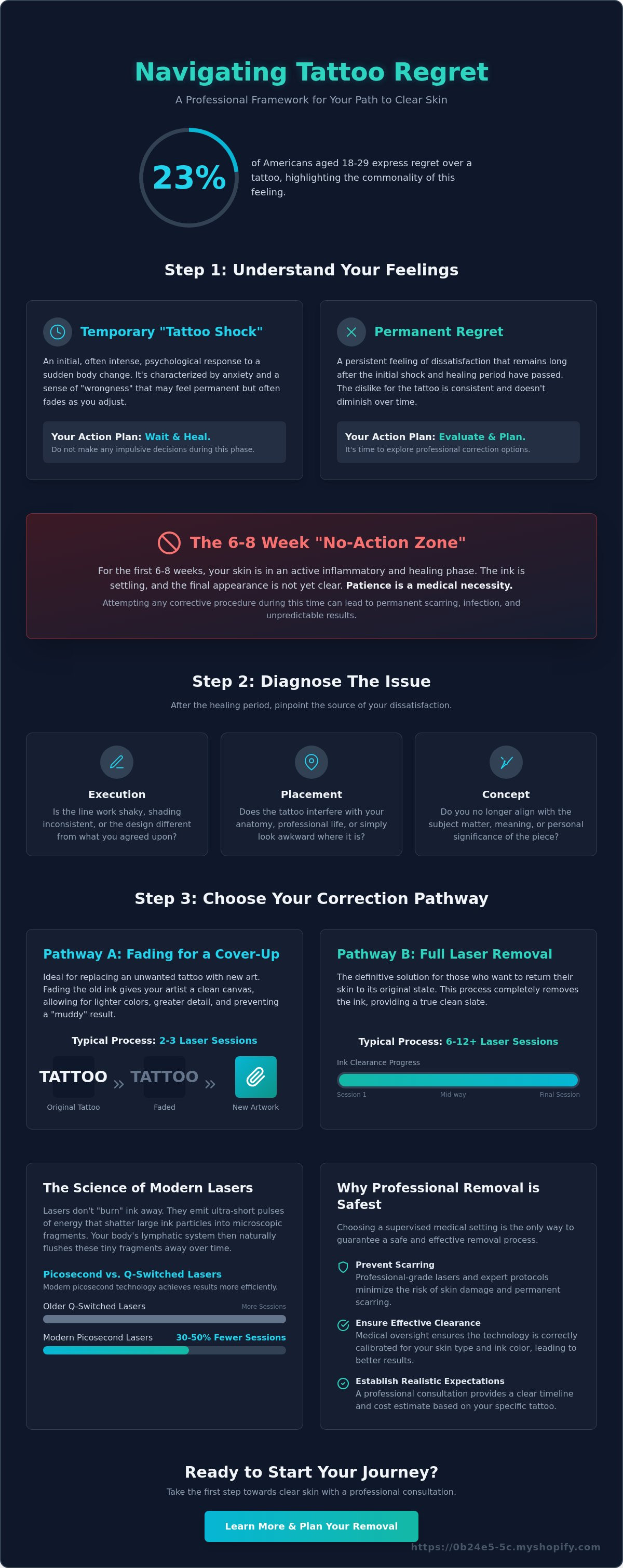
Approximately 23% of Americans between the ages of 18 and 29 express regret over their ink, a statistic that highlights how common it is to feel uneasy about a permanent body change. If you're currently struggling with an image that no longer fits your lifestyle, you need to know exactly what to do if you regret your tattoo to avoid unnecessary skin damage. It's natural to feel anxious about the removal process or fear that the mistake is permanent, but clinical solutions offer a reliable path forward.
We recognize that the immediate panic often called "tattoo shock" can make it difficult to think clearly about your next steps. This guide provides a professional framework for managing your options with transparency and precision. You'll learn how to distinguish between fading for a cover-up and achieving full removal through medical-grade technology. We also examine how modern picosecond lasers can achieve results in 30% to 50% fewer sessions than older Q-switched models. This information will help you build a clear plan of action and provide the peace of mind that your skin can be restored safely.
Key Takeaways
- Identify the difference between temporary "tattoo shock" and permanent regret to ensure you wait the necessary 6-8 weeks before pursuing corrective actions.
- Discover what to do if you regret your tattoo by evaluating whether full laser removal or partial fading for a cover-up best suits your aesthetic goals.
- Understand the biological process of laser removal, where energy fragments ink for your lymphatic system to flush away over several clinical sessions.
- Learn why professional laser tattoo removal in a supervised medical setting is the safest way to prevent scarring and ensure effective ink clearance.
- Establish realistic expectations for your removal timeline, which typically involves 6-12 sessions spaced to allow for proper skin recovery and optimal results.
Understanding Tattoo Shock vs. Permanent Regret
Experiencing immediate dissatisfaction with a new tattoo is a common psychological phenomenon. Tattoo shock is a temporary neurological response to a permanent physical alteration. It occurs when the brain struggles to integrate a sudden, significant change to the body's image. This reaction is often characterized by intense anxiety or a sense of "wrongness" that can feel like permanent regret, but it frequently dissipates as the brain adjusts to the new visual stimulus. Knowing what to do if you regret your tattoo starts with recognizing this psychological state and resisting the urge to act impulsively.
The 6-Week Rule: Why Patience is Your Best Tool
During the first 6 to 8 weeks, your skin is in an active inflammatory phase. The ink is still settling into the dermis, and the surface is scabbing and peeling. Attempting any corrective procedure during this "No-Action Zone" is medically ill-advised. It can lead to permanent scarring, infection, and unpredictable ink migration. Patience is essential because the final appearance of a tattoo cannot be judged until the skin has fully regenerated. Making a decision while the skin is still scabbing often leads to poor outcomes and may complicate future modern laser tattoo removal. Managing the emotional "panic phase" requires acknowledging that your current feelings may be a byproduct of healing rather than a permanent dislike of the art.
Assessing the Source of Your Dissatisfaction
To determine if your feelings are permanent, you must analyze the specific cause of your discomfort once the initial shock wears off. Identifying these factors is the first logical step in determining what to do if you regret your tattoo over the long term. Consider the following variables:
- Execution: Is the line work objectively shaky or the shading inconsistent with the agreed-upon design?
- Placement: Does the tattoo interfere with your natural anatomy, muscle movement, or professional requirements?
- Concept: Do you simply no longer align with the subject matter or the personal meaning behind the piece?
Differentiating between "bad art" and "wrong timing" is vital. Bad art is a technical failure that requires a clinical solution. "Wrong timing" suggests the concept or placement is the issue, which might require a different strategic approach. If your dissatisfaction persists after the 8-week healing period, you've moved from temporary shock to actionable regret. At this stage, you can begin evaluating medical-grade removal or alteration options with a clear and objective mindset.
Often, the decision to remove a tattoo is driven by a desire to enter a new professional field. If you are preparing for a career transition in Florida that involves state-mandated background checks, you can learn more about Level 2 Live Scan Fingerprinting and Background Check Submissions to ensure you meet all necessary employment criteria.
Evaluating Your Correction Options: Cover-ups vs. Removal
Once the initial healing window passes, you must decide between hiding the work or eliminating it entirely. Understanding what to do if you regret your tattoo involves weighing the technical requirements and long-term outcomes of each path. While some individuals choose stylistic alterations or "blackout" tattoos to mask mistakes, these options have significant limitations. Blackout tattoos require extreme ink saturation that results in a heavy, solid aesthetic that's nearly impossible to reverse later. A more functional strategy involves using clinical technology to prepare the skin for superior results.
Successful corrections often require a collaborative effort between your tattoo artist and a medical provider. An artist can identify which parts of the original design will "ghost" through a new piece, while a technician performs laser removal services to target those specific areas. This dual approach ensures that the final result is aesthetically pleasing and structurally sound.
When to Choose Laser Fading for a Cover-Up
Many people assume a cover-up is a simple matter of tattooing over the old image. However, attempting to cover a dark, fresh tattoo without prior treatment frequently leads to ink saturation. This causes the old tattoo to bleed through the new one, creating a muddy or cluttered appearance. By undergoing two to three laser sessions, you can fade the existing pigment enough to give your artist a workable surface. This process expands your design options, allowing for lighter colors and more intricate details that would otherwise be impossible to achieve over dark, dense ink.
The Path to a Clean Slate: Full Laser Removal
Full removal is the preferred choice for those who want to return their skin to its original state. The ideal candidate for total pigment clearance is someone with a healthy immune system and the patience to follow a clinical timeline. This path requires a higher commitment than fading, as it involves a complete series of sessions to break down all ink layers. While cover-ups hide the error, laser removal restores the canvas. Because this is a medical procedure, it's vital to choose FDA-regulated tattoo removal methods to ensure skin integrity throughout the process. Deciding what to do if you regret your tattoo depends on your long-term goals for your skin’s appearance and your willingness to invest the necessary time.
The Science of Modern Laser Tattoo Removal
Modern laser technology operates on the principle of selective photothermolysis. This process involves delivering ultra-short pulses of light energy to the ink particles trapped in the dermis. The ink absorbs this energy, which causes it to shatter into microscopic fragments. Because these laser pulses are so rapid, the energy interacts specifically with the pigment while leaving the surrounding skin tissue largely unaffected. This precision is a critical part of what to do if you regret your tattoo safely. According to the FDA guide to tattoo removal, lasers are the most common and effective method for clearing unwanted ink.
Once the ink is fragmented, your body's immune system takes over. The lymphatic system identifies these small particles as waste and gradually transports them to be flushed from the body. This biological process explains why removal requires multiple sessions; the body needs time to process the debris between treatments. The effectiveness of this process also depends on the specific laser wavelength used. For example, 1064 nm wavelengths are highly effective for black and dark blue inks, while 532 nm wavelengths are necessary to target red and orange pigments.
Ink Pigments and Your Immune System
The age of your tattoo significantly impacts the removal timeline. Older tattoos are generally easier to clear because your immune system has already spent years naturally breaking down the pigment. In contrast, fresh ink is densely packed and more resistant to fragmentation. Certain colors, such as neon greens and light blues, are historically more difficult to remove and require advanced equipment to reach the specific depths where those pigments sit. Your overall metabolic health also plays a role. Patients with active lifestyles and proper hydration often see faster results, as their lymphatic systems are more efficient at clearing the shattered ink particles.
Medical-Grade Technology vs. DIY Risks
It's vital to avoid "at-home" solutions like removal creams or saline kits. These products often rely on harsh chemicals that can cause permanent scarring or chemical burns without actually reaching the ink in the dermis. Professional med spa equipment is designed to protect skin integrity while maximizing ink clearance. For those concerned about the overall texture and health of their skin during or after the removal process, Advanced Laser & RF Treatments can help maintain skin elasticity and promote healing. Choosing medical-grade technology is the only reliable way to ensure you're doing what to do if you regret your tattoo without risking long-term skin damage.
Planning Your Removal Journey in Bradenton, FL
Successful tattoo removal requires a structured commitment over several months. While getting a tattoo may take a single afternoon, removing it is a marathon that demands patience and consistent physiological recovery. When determining what to do if you regret your tattoo, you must account for a series of 6 to 12 sessions on average. These appointments are spaced approximately 8 weeks apart to allow the lymphatic system sufficient time to process and flush the fragmented ink. Attempting to shorten this recovery period does not accelerate the process. Instead, it increases the risk of skin irritation and reduces the overall efficacy of subsequent treatments.
Preparation begins several weeks before you enter the clinic. High levels of hydration are essential because water supports the metabolic functions necessary for efficient ink clearance. You should also avoid any blood-thinning medications or supplements unless medically necessary, as these can increase bruising during the procedure. Total sun avoidance in the treatment area is mandatory for at least four weeks prior to your appointment to ensure the skin is in a stable, non-reactive state.
Sun Safety and Laser Removal in the Florida Climate
Living in Bradenton presents unique logistical challenges for laser patients due to the high UV index. A tan increases the amount of melanin in the skin, which can cause the laser to target your natural pigment rather than the tattoo ink. This leads to potential complications like hyperpigmentation or blistering. Residents must follow strict SPF 50+ protocols and keep the treatment area covered with UV-protective clothing whenever outdoors. Many individuals find that starting their removal journey in the late fall or winter is the most effective strategy for managing sun exposure in the Sunshine State.
Managing Discomfort and Aftercare
The sensation of laser removal is often described as a rapid series of rubber band snaps against the skin. While the procedure is brief, managing the immediate post-treatment phase is vital for skin health. You may notice a white, bubbly appearance known as "frosting" immediately after the laser passes over the ink. This is a normal clinical response caused by the release of carbon dioxide as the ink shatters. It typically subsides within minutes. Essential aftercare involves keeping the area clean, avoiding high-heat environments like saunas or hot tubs, and applying professional-grade topical barriers. To begin your personalized treatment plan, you can explore our laser removal services to understand the specific protocols used in our facility.
Why Professional Med Spa Removal is the Safest Choice
Choosing a clinical environment over a standard tattoo shop for removal is a decision based on safety and precision. While some tattoo studios offer fading services to facilitate cover-ups, these settings often lack the medical-grade equipment and sterile protocols required for deep dermal procedures. Professional med spas operate under strict clinical standards, ensuring that every session occurs in a controlled, hygienic space. This environment is essential for preventing secondary infections and managing the skin's physiological response to laser energy. If you're deciding what to do if you regret your tattoo, prioritizing a medical setting reduces the risk of long-term complications like scarring or permanent texture changes.
Aestheticians in a med spa setting also provide a level of customization that's unavailable in non-medical facilities. They calibrate laser settings based on your specific skin type, the depth of the ink, and your overall skin health. This technical precision ensures that the energy effectively shatters pigment without causing thermal damage to the surrounding tissue. This level of care is especially important for patients with darker skin tones, who require specific wavelengths and pulse durations to avoid pigment changes. A professional practitioner monitors your skin’s reaction during every pulse, making real-time adjustments to ensure the treatment remains within safe clinical parameters. Understanding what to do if you regret your tattoo involves more than just finding a laser; it requires finding the right clinical expertise to guide your skin's recovery.
Beyond Removal: Restoring Your Skin’s Health
Total ink clearance is only one part of the restoration process. Sometimes, the original tattooing process or the subsequent removal sessions can alter the skin's texture. Integrating removal with other skin rejuvenation services, such as RF or microneedling, helps restore a smooth, natural appearance. For example, using SkinPen or Morpheus8 after your laser sessions can stimulate collagen production to address any underlying textural irregularities. The Organic Skin & Body Med Spa approach focuses on this holistic recovery, ensuring your skin looks healthy once the ink is gone. You can learn more about local standards for these procedures in our guide to The Best Spas in Bradenton, FL.
Taking the First Step: Your Consultation
A face-to-face consultation is the most effective way to establish a realistic clinical plan. During this assessment, a professional will examine the tattoo's size, age, and color density while reviewing your medical history. Transparency about your current medications and health status is vital, as certain factors can influence how quickly your body flushes the fragmented ink. This meeting allows you to ask technical questions and receive a clear estimate of the number of sessions required for your specific case. When you're ready to proceed, Schedule your laser tattoo removal consultation in Bradenton today.
Taking Control of Your Skin’s Future
Navigating the emotional and physical complexities of tattoo regret requires a logical, clinical strategy. You now understand that identifying the difference between temporary "tattoo shock" and permanent dissatisfaction is the first step in deciding what to do if you regret your tattoo. By choosing medical-grade laser technology over unverified home remedies, you ensure that ink is shattered safely without compromising your skin's integrity. This professional path minimizes the risk of scarring and ensures that your lymphatic system can efficiently process fragmented pigments.
Our certified laser technicians in Bradenton provide the technical precision needed to manage the removal marathon from start to finish. We combine advanced laser protocols with a holistic approach to skin rejuvenation and aftercare to ensure your skin remains resilient throughout the transition. Whether you're seeking a clean slate or precisely fading an area for a high-quality cover-up, professional guidance is essential for achieving predictable, high-quality results. Your skin's health is our priority as we work to correct past mistakes with modern medical solutions.
Book Your Laser Tattoo Removal Consultation and begin your journey toward restored skin today.
Frequently Asked Questions
How long do I have to wait after getting a tattoo to start removal?
You must wait at least 6 to 8 weeks before beginning laser treatment on a new tattoo. This period allows the skin to complete its initial inflammatory phase and ensures the ink has fully settled into the dermis. Attempting removal earlier can cause severe skin damage and increase the risk of infection. Your skin must be entirely healed with no remaining scabs or irritation before the first clinical session can safely occur.
Will laser tattoo removal leave a permanent scar?
Modern laser technology is designed to target ink particles without damaging the surrounding skin tissue, making permanent scarring rare. The risk depends heavily on your adherence to aftercare protocols and the expertise of your technician. Patients who follow hydration and sun protection guidelines typically see clear results without textural changes. Using advanced equipment in a medical setting further ensures the skin remains healthy throughout the fragmentation process.
Is it more painful to get a tattoo or to have it removed?
Most patients report that laser removal feels like a quick succession of rubber band snaps against the skin. While the sensation is intense, the sessions are significantly shorter than the time required to receive a tattoo. Many individuals find the discomfort manageable because the laser passes over the area very rapidly. Clinical settings often use cooling methods to minimize heat and improve the patient's comfort during the brief procedure.
Can all tattoo colors be completely removed?
Most ink colors can be successfully cleared, though black and dark blue respond most efficiently to standard laser wavelengths. Stubborn colors like neon green, yellow, and light blue often require specific medical-grade technology to break down. When considering what to do if you regret your tattoo, a professional assessment can determine the likely success rate for your specific pigment palette and skin type.
How much does laser tattoo removal cost in Bradenton, FL?
The total investment for tattoo removal in Bradenton depends on the size, color density, and age of the ink. Each case requires a different number of sessions to achieve the desired level of clearance, which influences the final cost. You should schedule a clinical consultation to receive a personalized estimate. This assessment accounts for your specific tattoo complexity and the number of treatments needed to reach your aesthetic goals.
What happens if I expose my removal site to the sun?
Exposing the removal site to the sun can lead to hyperpigmentation or severe blistering during the recovery phase. UV rays increase melanin production, which interferes with the laser's ability to target only the ink particles. Residents in sunny climates must use SPF 50+ and keep the area covered to ensure the skin remains stable for treatment. Sun-damaged skin cannot be safely treated until the irritation has completely subsided.
How many sessions will I actually need to see results?
Most patients require between 6 and 12 sessions to achieve full pigment clearance, though visible fading often begins after the first few treatments. This timeline varies based on your immune system's efficiency and the saturation of the ink. Sessions are spaced several weeks apart to give your body time to flush the fragmented particles. Completing the full series as recommended by your technician is essential for achieving a clean slate.
Can I get a new tattoo over the area after it has been removed?
You can get a new tattoo over the treated area once the skin has fully healed from the final laser session. Professional artists often prefer a faded canvas because it provides more design flexibility and prevents the old ink from bleeding through the new art. Understanding what to do if you regret your tattoo includes planning for this final aesthetic stage after clinical clearance and skin restoration are complete.