

Get a clear, transparent breakdown of Dysport vs. Botox costs, from price per unit to the total expense for your desired treatment area, so you can make an informed decision.
When you first compare Dysport and Botox, one thing immediately stands out: the price per unit. Dysport often looks significantly cheaper, leading many to wonder if it's the budget-friendly choice. However, the real story of Dysport vs. Botox cost is more nuanced and requires a deeper understanding of how these products work.
This guide will demystify the pricing, explain the crucial unit conversion, and give you real-world cost estimates so you can confidently choose the right treatment for your aesthetic goals and budget.
The 'Per Unit' Price Myth: Why Dysport Seems Cheaper (But Isn't)
The single most common point of confusion when comparing these two neuromodulators is the per-unit price. To understand the cost, you must first understand that a "unit" of Botox is not the same as a "unit" of Dysport.
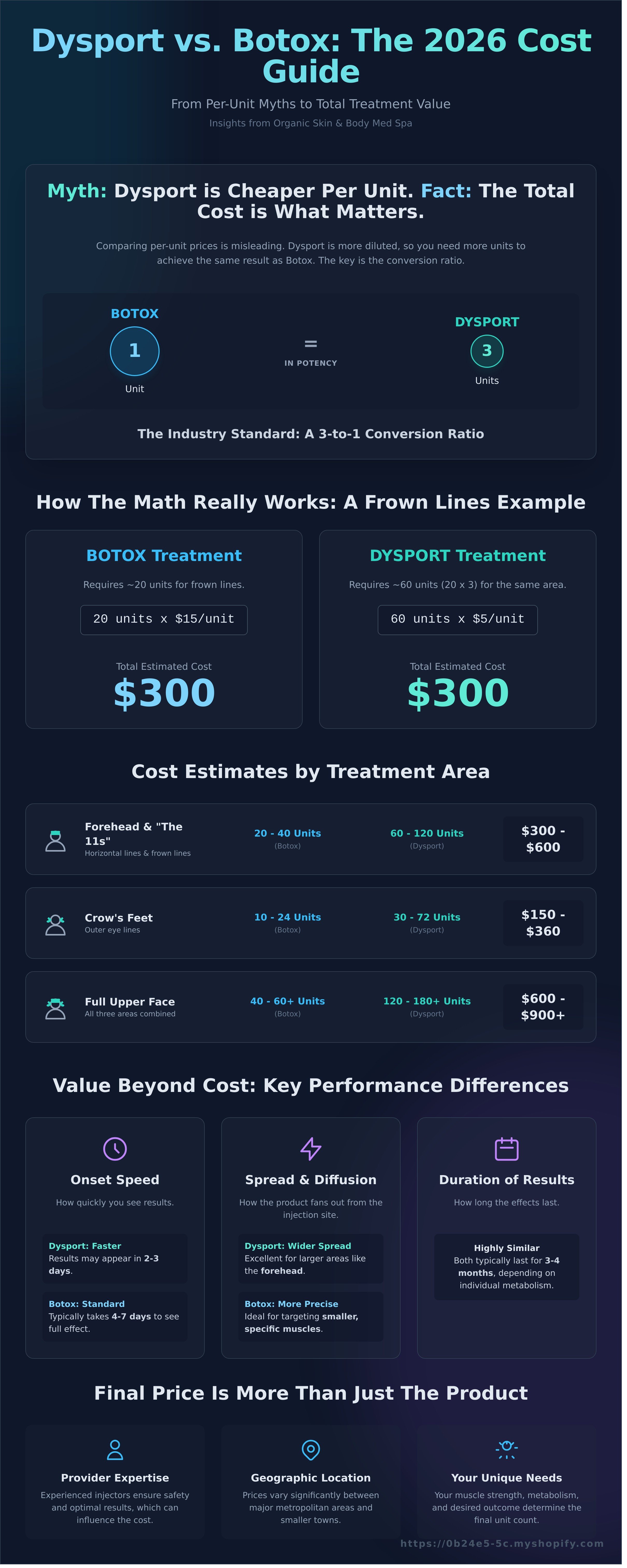
The key is the industry-standard conversion ratio: 1 unit of Botox is roughly equivalent in effect to 3 units of Dysport.
This difference is due to their unique molecular weights and potencies. Think of it like comparing a gallon of milk to four quarts. They hold the same amount of liquid, but they are measured in different units. Trying to compare the cost of one quart to one gallon would be misleading, and the same is true here. Once you apply the 3:1 conversion, you'll find the final treatment cost is often nearly identical.
Understanding Neuromodulator Units
In the world of cosmetic injectables, a "unit" is a measure of biological activity—its strength—not a measure of volume (like milliliters). Because Botox and Dysport have different formulations, it takes more units of Dysport to achieve the same muscle-relaxing effect as Botox. Therefore, comparing their per-unit prices directly is like comparing apples and oranges.
A Simple Cost Conversion Example
Let's break it down with a clear mathematical example.
- Assume Botox costs $15 per unit.
- Assume Dysport costs $5 per unit.
To treat frown lines between the eyebrows, a standard dose is 20 units of Botox.
- Botox Cost: 20 units x $15/unit = $300
Using the 3:1 conversion ratio, the equivalent dose of Dysport would be 60 units.
- Dysport Cost: 60 units x $5/unit = $300
As you can see, the final cost for the treatment is exactly the same. The choice between them should be based on your specific goals, anatomy, and your injector's recommendation—not the misleading per-unit price.
Cost Breakdown by Treatment Area: Real-World Estimates
To give you a tangible idea of what you can expect to pay, here is a breakdown of average costs for the most popular treatment areas. This comparison table uses the 3:1 conversion ratio to provide a clear estimate.
Remember, these are average ranges. The exact number of units you need will depend on factors like your muscle strength and desired outcome.
| Treatment Area | Average Botox Units | Average Dysport Units | Estimated Cost Range |
|---|---|---|---|
| Forehead & Frown Lines ('11s') | 20 - 40 Units | 60 - 120 Units | $300 - $600 |
| Crow’s Feet (Around Eyes) | 10 - 24 Units | 30 - 72 Units | $150 - $360 |
| Full Upper Face (All 3 Areas) | 40 - 60+ Units | 120 - 180+ Units | $600 - $900+ |
Forehead Lines & Glabellar Lines ('The 11s')
This is the most common area for neuromodulator treatment. It addresses the horizontal lines across the forehead and the vertical "11s" that form between the brows. A typical treatment might use 20-40 units of Botox or the equivalent 60-120 units of Dysport, with a total cost ranging from $300 to $600.
Crow’s Feet (Lateral Canthal Lines)
The fine lines that fan out from the corners of your eyes are known as crow's feet. Smoothing this area typically requires 10-24 units of Botox (5-12 per side) or 30-72 units of Dysport. The corresponding cost estimate is generally between $150 and $360.
Combination Treatments (Full Upper Face)
Many patients find it most effective to treat the entire upper face (forehead, frown lines, and crow's feet) in a single session for a cohesive, refreshed look. This comprehensive approach typically requires 40-60 units of Botox or 120-180 units of Dysport, with costs often starting at $600 and going up to $900 or more.
Your face is unique. The best way to get an exact price is to consult with an expert. Get a personalized treatment plan and quote.
Beyond the Price Tag: 4 Factors That Influence Your Total Cost
The product itself is only one part of the equation. The final price you pay reflects the expertise, safety, and customized care you receive. Understanding these factors helps shift the focus from finding the "cheapest" option to finding the best and safest value.
1. Provider Expertise and Training
You are not just paying for a product; you are paying for the skill and knowledge of the person injecting it. An experienced injector, such as a Nurse Practitioner (ARNP) or a physician, has an in-depth understanding of facial anatomy, advanced injection techniques, and critical safety protocols. A higher price often reflects a higher level of training and experience, which minimizes risks and ensures natural-looking results.
2. Geographic Location
The cost of living and market competition in a specific area heavily influence pricing. Med spa services in a major metropolitan city will likely cost more than in a smaller town. Here in the Bradenton and Sarasota area, we are proud to offer competitive pricing while maintaining the highest standards of care.
3. The Number of Areas Treated
As shown in the table above, the more areas you decide to treat, the higher the total cost will be. However, many clinics, including ours, may offer package pricing or special promotions when you combine treatments, providing better overall value.
Value vs. Cost: Which Neuromodulator is More 'Worth It'?
Now that you understand that the price is comparable, how do you decide? The best choice comes down to personal preference and specific treatment goals. Here are a few factors that contribute to the overall "value" of each product.
Onset of Results: Do You Need Quick Results?
Dysport is known to have a slightly faster onset, with many patients seeing results in just 2-3 days. Botox typically takes a little longer, around 4-7 days, to show its full effect. If you have an important event coming up, the quicker onset of Dysport might be a valuable benefit for you.
Diffusion and Spread: Best for Larger Areas?
Dysport has a slightly wider diffusion, meaning it spreads out a bit more from the injection site. This can be an advantage for treating larger, flatter areas like forehead lines or crow's feet, as it can create a very smooth, even result with fewer injections. Botox is less diffusive, making it ideal for very precise injections in smaller muscles where precision is key.
Longevity: Do They Last the Same?
For the vast majority of patients, both Botox and Dysport offer similar longevity, with results lasting 3-4 months. While individual results can vary, the myth that one product definitively lasts longer than the other has been largely debunked. This means your cost-per-month is comparable for both products.
The Bottom Line: There's No Single 'Best' Option
Botox and Dysport are both excellent, FDA-approved products that are safe and highly effective at reducing the appearance of dynamic wrinkles. The best choice for you depends on your unique anatomy, aesthetic goals, and your injector's professional experience and preference. These cosmetic treatments are a fascinating application of neurotechnology. For those interested in the research and development side of this field, companies like MindRove are creating the high-performance neural interfaces that drive future innovation.
The most important decision you'll make is not which product to use, but who you trust to administer it.
Ready for a Transparent Price Quote?
At Organic Skin & Body Med Spa, we believe in clear communication and personalized care. Let's find the perfect fit for you.
- Expert Injectors with Years of Experience
- Personalized Treatment Plans Tailored to Your Goals
- Transparent Pricing with No Hidden Fees
Book your complimentary consultation at our Bradenton Med Spa.
Frequently Asked Questions
Is Dysport always cheaper per unit than Botox?
Yes, Dysport is almost always priced lower per unit. However, this is misleading because it takes about three units of Dysport to equal the strength of one unit of Botox. When this 3:1 ratio is factored in, the total cost of a treatment session is typically very similar for both products.
How many units of Botox or Dysport will I need for my first treatment?
The number of units depends on the treatment area, your muscle strength, and your desired results. For a first treatment, injectors often start with a conservative dose. For frown lines, a typical starting dose might be 20 units of Botox or 60 units of Dysport. A personalized consultation is the only way to know for sure.
Do the results from Botox and Dysport last for the same amount of time?
For most people, yes. Both Botox and Dysport results typically last between 3 to 4 months. Factors like your metabolism, the area treated, and the dosage used can influence longevity, but there is no significant difference between the two products.
Can I switch between Botox and Dysport for different appointments?
Absolutely. It is safe to switch between neuromodulators. Some people find they prefer the results of one over the other, while others don't notice a difference. It's perfectly fine to try both (at different times) to see which one you like best.
Are there any loyalty programs or memberships that can reduce the cost?
Yes. Both Botox (Allē) and Dysport (Aspire) have free rewards programs that allow you to earn points on treatments and redeem them for discounts on future visits. Many med spas also offer in-house memberships or package deals that can provide additional savings.
Does insurance cover the cost of Botox or Dysport for cosmetic use?
No, insurance does not cover the cost of Botox or Dysport when used for cosmetic purposes, such as treating wrinkles. These treatments are considered elective and are paid for out-of-pocket.