

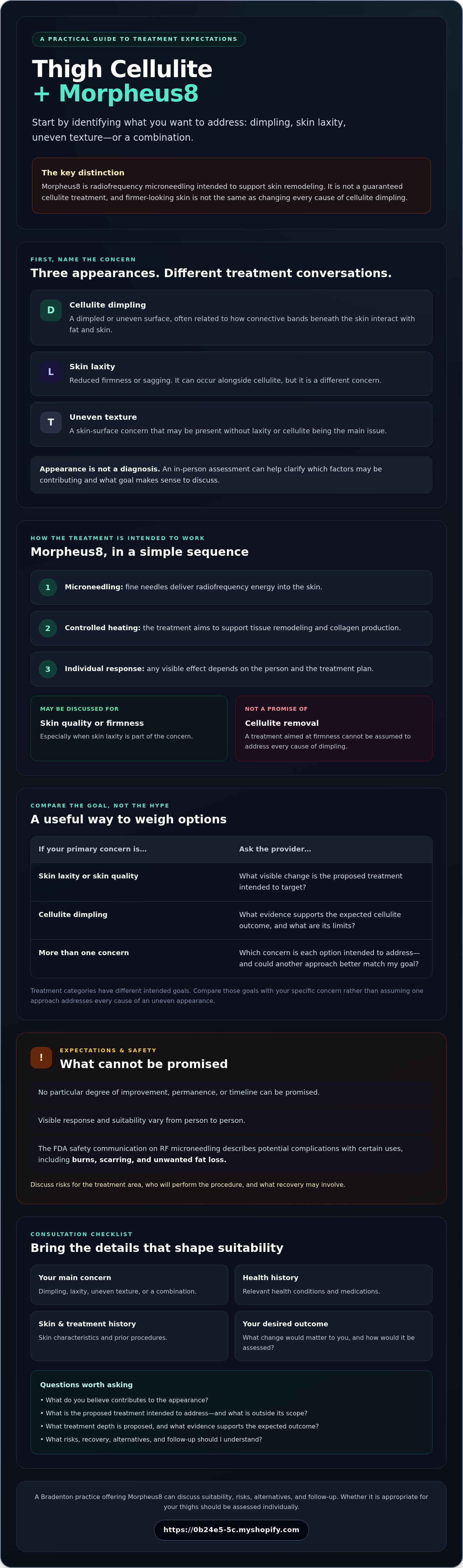
The most visible part of thigh cellulite may not be the part Morpheus8 can change. If you’re considering morpheus8 for cellulite thighs, first ask whether your main concern is skin laxity, uneven texture, cellulite dimpling, or a combination. That distinction matters because a treatment intended to support skin firmness can’t be assumed to address every cause of dimpling.
It’s reasonable to want clear answers about likely results, discomfort, recovery, and whether another approach may better suit your goals. Morpheus8 uses radiofrequency microneedling and is intended to support skin remodeling, but it isn’t a guaranteed cellulite treatment. Individual results and suitability vary.
This article explains what Morpheus8 may and may not do for thigh cellulite, how it compares with other options, and what to ask during a consultation. Organic Skin & Body Med Spa in Bradenton offers Morpheus8, but whether it’s appropriate for your thighs should be assessed individually. Use this guide to set realistic expectations, weigh potential trade-offs, and prepare questions for a provider.
Key Takeaways
- Distinguish cellulite dimpling from skin laxity and uneven texture so you can clearly describe your main concern.
- Understand what morpheus8 for cellulite thighs may address and which expectations to discuss before treatment.
- Compare treatment categories by their intended goals, then ask how each option relates to your specific concern.
- Prepare for a consultation by noting relevant medications, health conditions, prior procedures, and skin concerns.
- Use a consultation at a Bradenton practice offering Morpheus8 to discuss suitability, risks, alternatives, and follow-up.
Morpheus8 for Cellulite on the Thighs: What Concern Can It Address?
Thigh dimpling is common, but its appearance and response to treatment vary from person to person. Cellulite describes a dimpled or uneven surface, often related to how connective bands beneath the skin interact with fat and skin. Loose skin is different: it refers to reduced firmness or sagging. Uneven texture may also be present without either being the main concern.
Cellulite is surface dimpling related to underlying tissue structure; skin laxity is reduced firmness, and the two concerns can occur together. Appearance alone can’t identify the specific tissue factors involved. An in-person assessment can help clarify whether your goal is to address skin quality, laxity, cellulite’s visible pattern, or a combination.
Why cellulite and loose skin are not the same concern
A thigh may look dimpled when standing, while the skin may also appear less firm in another position. Those observations describe appearance, not a diagnosis. Skin texture, laxity, and underlying tissue structure can contribute in different ways. A treatment intended to improve skin firmness may not address the structural features behind cellulite, so defining your main concern first makes the treatment discussion more specific.
What Morpheus8 is designed to do
Morpheus8 is a form of radiofrequency (RF) microneedling. Fine needles deliver RF energy into the skin, with the aim of supporting tissue remodeling and collagen production. The intended depth and settings depend on the device and treatment plan, so confirm any claims about a particular thigh protocol with the provider. General information about radio-frequency skin tightening explains the broader technology, but it doesn’t establish what an individual treatment will achieve.
For morpheus8 for cellulite thighs, distinguish a possible improvement in skin quality or firmness from a promise to remove cellulite. Morpheus8 may be discussed when skin laxity is part of the concern, but that doesn’t mean it will correct every cause of dimpling. Ask what visible change the provider expects to target, what evidence supports that expectation, and whether another approach may better match your concern.
For more background on the device, see What is Morpheus8? A Beginner’s Guide to RF Microneedling. Understanding the technology is a starting point; an individualized assessment is needed to determine whether it fits your goals.
How Morpheus8 May Affect Thigh Skin, and Where Its Limits Matter
Morpheus8 combines microneedling with radiofrequency (RF) energy. The needles deliver energy into the skin, where controlled heating is intended to support tissue remodeling and collagen production. These are treatment goals, not a guarantee of a particular visible change. Any effect on thigh skin depends on the individual and the treatment plan.
That distinction matters because smoother-looking or firmer skin isn’t the same as changing the tissue structure associated with cellulite dimpling. A clinician may discuss Morpheus8 if skin quality or laxity is part of your concern, but that alone doesn’t establish that it will improve cellulite. Treatment choice depends on the concern being assessed, the person’s health and skin characteristics, and the outcome they want.
What a treatment assessment should evaluate
An assessment should clarify whether your main concern is dimpling, laxity, uneven texture, or a combination. Medical history, medications, skin characteristics, prior procedures, and personal goals can all affect suitability and which risks need discussion. A photograph or one symptom isn’t enough to determine candidacy. Ask the provider to explain what they believe contributes to the appearance and what the proposed treatment is intended to address.
What Morpheus8 cannot promise for cellulite
Morpheus8 should not be presented as guaranteed cellulite removal. Visible response and suitability vary, and no particular degree of improvement, permanence, or timeline can be promised. Ask about the device’s specific indications, the proposed treatment depth, and the evidence for cellulite outcomes. Then ask which outcome is realistic for your concern and how it would be assessed.
RF microneedling also has risks. The FDA safety communication on RF microneedling describes potential complications associated with certain uses, including burns, scarring, and unwanted fat loss. Discuss the risks relevant to your treatment area, who will perform the procedure, and what recovery may involve. General information about RF microneedling can’t predict your individual risk or outcome.
If you’re considering morpheus8 for cellulite thighs, use a consultation to discuss your goals and whether the treatment is appropriate, rather than relying on broad claims. You can ask about Morpheus8 treatment suitability as part of that conversation.
Morpheus8 vs. Other Cellulite Approaches: Compare the Goal, Not the Hype
Different treatments may be considered for different visible concerns. RF microneedling is one category a provider may discuss when skin quality or laxity is part of the goal. Other clinician-selected approaches may focus more directly on cellulite dimpling or a different aspect of the skin’s appearance. These categories aren’t interchangeable, and no option should be called the best without considering the assessment, evidence, risks, and your priorities.
Use the comparison below to guide questions, not to diagnose yourself or choose a procedure based on its label. A qualified provider should confirm treatment details and suitability.
| Concern being assessed | Treatment category | Questions to ask |
|---|---|---|
| Skin texture or laxity | RF microneedling, such as Morpheus8 | Is this approach intended to address my skin-quality concern? Is it appropriate for the thigh area, and what evidence supports the expected changes? |
| Cellulite dimpling | Clinician-selected cellulite-focused procedures | What tissue or feature is the procedure intended to target? How closely does the available evidence match my type of dimpling? |
| More than one concern | An individualized plan, which may consider different treatment categories | Which concern should be addressed first? What are the relative risks, limits, and follow-up requirements of each option? |
When skin texture or laxity is the main concern
When cellulite dimpling is the main concern
If you’re weighing morpheus8 for cellulite thighs against other options, compare each approach using the same criteria: the concern it targets, evidence for that concern, potential risks, and the outcome you consider worthwhile. To explore how different body sculpting and contouring techniques compare across the industry, read more about current methods and their targets. A consultation can help clarify those points without assuming one technology will suit everyone.
How to Decide Whether Morpheus8 for Thighs Is Worth a Consultation
A consultation can help you determine whether Morpheus8 is relevant to your concern; it doesn’t commit you to treatment. Before booking, write down what you want to change and where you notice it. Dimpling, loose skin, and uneven texture can call for different treatment goals, so be specific about what matters most to you.
Use these steps to prepare:
- Define your concern. Note whether you’re focused on cellulite dimpling, skin laxity, texture, or a combination. Describe when the concern is most visible instead of trying to identify its cause yourself.
- Review your health history. Be ready to discuss medications, relevant health conditions, prior procedures, and current skin concerns in the area. Ask whether any of these factors could affect suitability, risks, or preparation.
- Ask about the treatment area and alternatives. Confirm whether the clinician treats thighs with Morpheus8, what concern the proposed treatment is intended to address, and what other approaches might fit your goals.
- Understand the next steps. Request clear information about potential risks, preparation, recovery, follow-up, and how the provider will assess visible changes. Don’t assume a treatment schedule or result without an individualized recommendation.
Questions to ask at a Morpheus8 consultation
Useful questions include: “Do you treat thighs, and what specific concern would Morpheus8 target in my case?” “What alternatives could address my cellulite or skin-quality concern?” “What are the risks and possible recovery needs for this area?” Ask how follow-up is handled and what changes would be realistic to look for. Clear answers should relate to your goals and medical history, not promise identical outcomes for everyone.
How to assess claims and provider guidance
Look for an explanation that connects the recommendation to your assessment and acknowledges uncertainty. Be cautious of guaranteed cellulite removal or claims that one approach works the same way for every person. A Bradenton spa guide may offer background on local options, but it can’t replace a direct discussion of your medical history and treatment suitability.
If you’re considering morpheus8 for cellulite thighs, use these questions to decide whether further discussion makes sense. Explore Morpheus8 at Organic Skin & Body Med Spa and ask about your goals, suitability, and treatment details.
Considering Morpheus8 in Bradenton? What to Expect from a Local Consultation
Organic Skin & Body Med Spa is a Bradenton practice that offers Morpheus8. If you’re considering morpheus8 for cellulite thighs, contact the clinic to confirm whether it currently evaluates and treats thighs with this device. The practice’s general Morpheus8 offering doesn’t confirm a thigh-specific protocol or establish that the treatment is appropriate for cellulite.
Use the consultation to understand what the provider would assess and what the treatment could realistically target in your case. Bring clear goals, such as addressing visible dimpling, skin laxity, or both. The discussion should also cover possible risks, alternatives, and what is known about preparation, recovery, and follow-up. You should have enough information to decide whether to proceed, ask more questions, or consider another option.
What to clarify before scheduling treatment
Before committing to treatment, confirm the clinic’s current approach to thighs and ask who would perform the procedure. Find out what individualized assessment informs the recommendation, including how the provider distinguishes your main concern from other skin or tissue features. Ask for current guidance on preparation, recovery, follow-up, and risks, and share medications, relevant health conditions, prior procedures, and skin concerns.
Consider asking:
- Do you currently evaluate and treat the thigh area with Morpheus8?
- What concern would treatment target in my case, and what alternatives could be appropriate?
- What risks and recovery considerations should I understand before deciding?
- How will you assess whether the treatment is suitable for me and discuss potential changes?
Making an informed next step in Bradenton
Good guidance should connect the recommendation to your goals and health history. It should explain uncertainty rather than promise cellulite removal or identical results for every person. If you leave without understanding the proposed target, risks, or follow-up, it’s reasonable to pause and seek clarification. Choosing not to proceed is also a valid decision if important concerns remain unanswered.
A local conversation can help you decide whether Morpheus8 merits further consideration, without pressure to book treatment. To ask the practice about its current Morpheus8 service and whether thigh treatment can be discussed, Contact Organic Skin & Body Med Spa about Morpheus8.
Make Your Next Step an Informed One
The decision about morpheus8 for cellulite thighs starts with identifying what you want to address. Cellulite dimpling, skin laxity, and uneven texture can call for different treatment goals, and Morpheus8 shouldn’t be treated as a guaranteed solution for cellulite. Ask how the recommendation relates to your concerns, what alternatives may be appropriate, and what risks and recovery considerations apply to you.
Organic Skin & Body Med Spa in Bradenton, Florida, offers Morpheus8 among its advanced RF and aesthetic treatments. A discussion can help you clarify your goals and ask whether the practice currently assesses thighs for this treatment. Confirm suitability and ask about the approach before deciding whether to proceed.
Discuss your Morpheus8 goals with Organic Skin & Body Med Spa. Take the time you need to understand your options and choose the next step that feels right for you.
Frequently Asked Questions
Can Morpheus8 reduce cellulite on the thighs?
Morpheus8 may be discussed as an option, but it can’t be assumed to remove thigh cellulite. It uses radiofrequency microneedling, and whether it’s appropriate depends on what contributes to your concern. A clinician should assess whether dimpling, skin laxity, uneven texture, or a combination is the main goal. Ask what change is realistic for you, what evidence supports the recommendation, and whether another approach may be a better fit.
Is Morpheus8 specifically designed to treat cellulite?
Morpheus8 is a radiofrequency microneedling treatment, but that description alone doesn’t establish that it’s intended or suitable for every cellulite concern. A treatment discussed for skin quality may not address all the factors behind visible dimpling. Ask the clinician what the proposed treatment is intended to target, what evidence supports its use for your specific concern, and which alternatives could be considered. Confirm device guidance and treatment details with the provider.
How many Morpheus8 treatments are needed for thigh cellulite?
There isn’t a session count that applies to everyone seeking treatment for thigh cellulite. A recommended plan depends on the area being considered, the clinician’s assessment, the treatment protocol, and how your skin responds. Ask why a particular plan is being suggested, when progress would be reviewed, and what options exist if the outcome differs from your expectations. Don’t assume a fixed number of sessions before receiving an individualized recommendation.
Is Morpheus8 painful on the thighs, and what is recovery like?
Sensation and recovery can vary depending on the person and treatment plan. Before deciding, ask the provider what discomfort may feel like, what comfort measures may be used, and what temporary effects or activity restrictions could apply. Request current aftercare instructions so you know how to care for the area. Discuss medications, health conditions, and skin concerns that might affect recovery before scheduling or proceeding.
Is Morpheus8 safe for everyone with thigh cellulite?
No, Morpheus8 isn’t automatically suitable for everyone with thigh cellulite. A clinician should review your health history, medications, skin, treatment area, and goals before making a recommendation. Ask about relevant risks, circumstances that could make treatment unsuitable or require postponement, and alternative approaches. General information online can help you prepare questions, but it can’t replace an individual assessment or determine whether the procedure is appropriate for you.
Does Morpheus8 permanently remove cellulite?
No permanent or guaranteed cellulite-removal result should be expected. The appearance of cellulite and an individual’s response to treatment can vary, so ask the provider to explain what change is intended and how it would be assessed. Claims about how long results last should be supported by current evidence. Before proceeding, discuss whether ongoing follow-up, maintenance, or another approach might be relevant to your goals.
How do I know whether Morpheus8 or another treatment is right for my thighs?
Start by identifying whether dimpling, laxity, uneven texture, or several concerns matter most to you. In a consultation about morpheus8 for cellulite thighs, ask the provider to connect each recommendation to your concern and explain the supporting evidence, potential risks, recovery, and alternatives. A useful recommendation should reflect your goals and health history, not promise the same result for everyone. Take time to decide if your questions remain unanswered.