

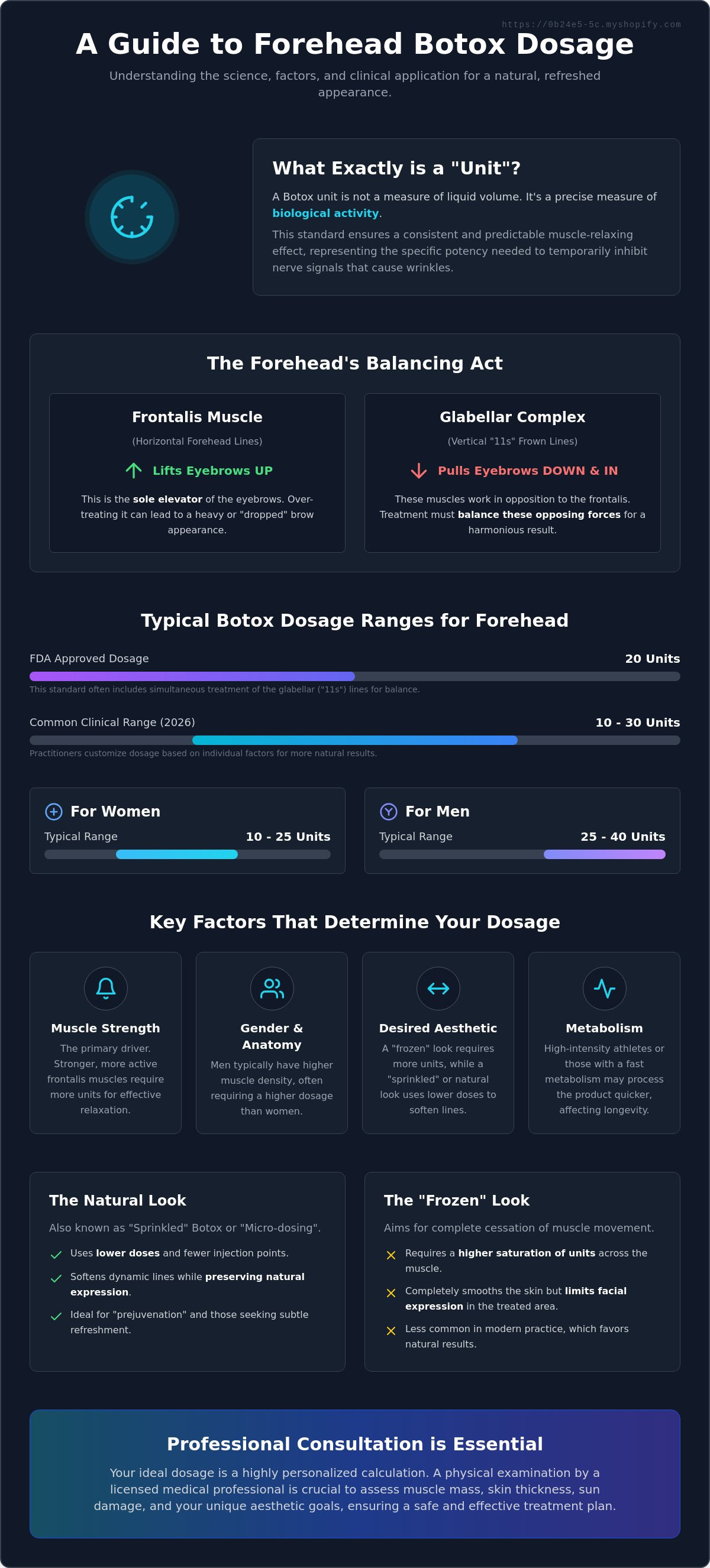
Achieving a refreshed appearance shouldn't require sacrificing your ability to show emotion. While the standard FDA-approved botox dosage for forehead lines is 20 units, clinical applications in 2026 often range from 10 to 30 units depending on your specific muscle strength and aesthetic goals. You likely want to soften horizontal lines without ending up with a "frozen" forehead that looks artificial or stiff. It's also common to feel confused by the choice between unit-based pricing and area-based pricing models during a consultation.
This guide clarifies exactly how a professional botox dosage for forehead is calculated and which biological factors influence your personalized treatment plan. You'll discover the clinical logic behind unit selection, including how muscle mass and "prejuvenation" trends affect the final count. We will also examine how practitioners balance dosage to ensure a smooth result that still allows for natural expression. By understanding these technical requirements, you can approach your next appointment with confidence in the logic behind your dosage and a clear expectation of your results.
Key Takeaways
- Identify how a "unit" represents a specific measure of biological activity and why the frontalis muscle’s unique anatomy dictates your results.
- Evaluate how individual muscle mass and gender influence your personalized botox dosage for forehead to ensure a natural, refreshed appearance.
- Compare standard clinical ranges for horizontal forehead lines and glabellar "11s" to better understand the typical unit requirements for common treatment areas.
- Learn why a professional physical examination is essential to account for local environmental factors like skin thickness and cumulative sun damage.
- Discover how to optimize your results by integrating injectables with advanced treatments like Morpheus8 and professional organic skincare.
Understanding Botox Units and Forehead Anatomy
Calculating the correct botox dosage for forehead treatments requires a technical understanding of how neurotoxins interact with specific facial muscles. A unit of Botox (OnabotulinumtoxinA) isn't a measurement of liquid volume. Instead, it's a precise measure of biological activity. This measurement represents the amount of product required to produce a consistent and predictable paralytic effect in the targeted tissue. When a practitioner discusses your dosage, they're determining the specific potency needed to temporarily inhibit the nerve signals that cause muscle contractions.
The primary focus of this treatment is the frontalis muscle. This is the large, thin muscle that covers the forehead and serves as the sole elevator of the eyebrows. When you lift your brows, the frontalis contracts, which eventually leads to the formation of horizontal lines. Treating this area is a delicate balancing act. Because the frontalis is the only muscle that pulls the brows upward, over-relaxing it can lead to a heavy or "dropped" brow appearance. This is distinct from the glabellar region, where vertical frown lines, often called "11s," are formed by muscles that pull the eyebrows inward and downward. Understanding the total botox dosage for forehead requires a practitioner to evaluate how these opposing muscle groups work together to maintain facial harmony.
The Science of Neuromodulators
At the cellular level, Botulinum toxin works by blocking the release of acetylcholine at the neuromuscular junction. Acetylcholine is the neurotransmitter responsible for signaling a muscle to contract. When this signal is interrupted, the muscle remains in a relaxed state, which allows the skin above it to smooth out over several days. It's vital to distinguish this process from dermal fillers. Fillers are used to restore lost volume or fill deep, static folds. Botox addresses the mechanical cause of dynamic wrinkles. Some practitioners may also utilize Dysport as an alternative. Dysport often has a higher diffusion rate, which can be beneficial for covering larger forehead areas with a softer transition between treated and untreated zones.
FDA Guidelines vs. Clinical Reality
Factors That Determine Your Botox Dosage
Determining the ideal botox dosage for forehead treatments is a process that relies heavily on your unique physiological profile. Muscle mass is the primary driver of this calculation. Patients with stronger, more active frontalis muscles require a higher concentration of units to achieve effective relaxation. If the dosage is too low for the muscle's strength, the results will fade prematurely or fail to smooth the skin entirely. Gender plays a significant role here. According to 2026 clinical data, male patients typically require 25 to 40 units for the forehead due to higher muscle density, while women often find success within the 10 to 25 unit range.
Your lifestyle and metabolic rate also influence how your body interacts with the product. High-intensity athletes or individuals with exceptionally high metabolisms may process neuromodulators faster than the average patient. This doesn't necessarily mean a higher initial dose is required, but it may necessitate more frequent maintenance appointments. Understanding the Clinical applications of botulinum toxin helps practitioners predict these variations and adjust your plan accordingly. Ultimately, your desired aesthetic outcome dictates the final count. A "frozen" look requires a higher saturation of units to completely stop movement, whereas "sprinkled" Botox uses lower doses to soften lines while preserving natural facial expressions.
If you're unsure about which approach fits your needs, consulting with a specialist about cosmetic injectables can provide clarity on your specific requirements.
Age and Skin Elasticity
The distinction between dynamic and static wrinkles is a critical factor in dosage selection. Dynamic wrinkles appear only during movement, while static wrinkles are visible even when the face is at rest. Younger patients in their 20s and 30s often utilize preventative Botox to stop dynamic lines from etching into the skin. This typically requires fewer units. Conversely, older patients with significant skin laxity must be treated with caution. Using an aggressive botox dosage for forehead in skin with low elasticity can inadvertently cause ptosis, or eyebrow drooping, because the muscle no longer has the strength to support the brow's position.
Previous Treatment History
Consistency in your treatment schedule creates a cumulative effect on the target muscles. Regular injections can lead to temporary muscle atrophy, meaning the muscle becomes weaker over time from lack of use. This often allows for longer intervals between sessions or a slight reduction in the number of units needed to achieve the same result. However, it's vital to follow professional guidance on timing. Improper dosing intervals or receiving injections too frequently can increase the risk of developing antibodies, which may make the treatment less effective in the future.
Clinical benchmarks provide a reliable starting point for most patients. For horizontal lines, the typical botox dosage for forehead ranges from 10 to 20 units. The glabellar region, focusing on the vertical "11" lines between the brows, generally requires 15 to 25 units. These ranges ensure effective muscle relaxation while maintaining safety and natural movement for the majority of the population.
Treating these areas as separate entities is a technical error. The frontalis muscle elevates the brow, while the glabella muscles pull it downward. If you treat the forehead alone, the downward-pulling muscles may become unopposed. This often leads to a heavy or "dropped" brow appearance. According to Botulinum Toxin Indications, practitioners must evaluate the entire upper face to maintain muscular equilibrium. Recent 2026 trends also show a rise in "Baby Botox," which utilizes 5 to 10 units for preventative refinement in younger patients. This micro-dosing technique allows for movement while preventing deep lines from forming.
The Dangers of Under-Dosing
Low-cost "bargain" units frequently lead to disappointing results. If the botox dosage for forehead is insufficient, the muscle may only be partially inhibited. This results in uneven skin texture or a treatment that lasts only a few weeks instead of months. One specific risk is the "Spock Brow." This occurs when the central muscle is relaxed but the lateral fibers remain active, causing the outer brow to arch excessively. You won't see the full effect of your dose until approximately 14 days after the injection, so it's best to wait before requesting a touch-up.
The Risks of Over-Dosing
Administering too many units can lead to brow ptosis. This condition occurs when the forehead muscle is too relaxed to hold the brow in its natural position. Patients often describe a "heavy forehead" sensation that makes the eyelids feel weighted. This effect is temporary but can take several weeks to resolve. A conservative approach is always safer for those new to injectables. It's easier to add a few units at a follow-up than to wait for an over-dosed area to regain movement. Professional injectors prioritize this balance to ensure you don't look frozen or unnatural.
The Importance of a Professional Med Spa Consultation
Relying on generic online guides to determine your botox dosage for forehead is a common mistake. A digital estimate can't account for the physical nuances of your facial structure or the specific strength of your frontalis muscle. A professional consultation allows an injector to observe how your skin folds and where your muscles are strongest during movement. In the Bradenton area, the Florida climate introduces unique variables that impact treatment efficacy. Chronic sun exposure often results in solar elastosis. This condition causes the skin to become thickened and less elastic. This change in skin quality requires a practitioner to adjust the injection depth and unit count to ensure the product reaches the targeted muscle effectively without causing unwanted heaviness.
Not everyone is a candidate for neurotoxins. Contraindications include pregnancy, breastfeeding, or certain neurological disorders like myasthenia gravis. To prepare for your appointment, you should avoid blood thinners, such as aspirin or ibuprofen, and alcohol for at least 24 hours. These substances increase the risk of bruising at the injection site. If you're ready to discuss a personalized plan, you can explore options for cosmetic injectables to see how they fit your aesthetic goals.
What to Expect During Your Assessment
During the assessment, your practitioner will perform an "animation test." They'll ask you to frown, squint, and raise your eyebrows to map out the specific pull of your muscles. This step is vital for determining the exact botox dosage for forehead that will yield a symmetrical result. You'll also discuss your medical history and establish a long-term maintenance schedule. Regular treatments every three to four months are typical for maintaining a smooth appearance while preventing the formation of new static lines.
Safety Standards in Florida Med Spas
Florida regulations specify who can legally perform injections. You should always verify that your injector is a licensed medical professional, such as a Nurse Practitioner (NP), Physician Assistant (PA), or Medical Doctor (MD). A sterile, clinical environment is essential for preventing infection and ensuring the integrity of the product. Organic Skin & Body Med Spa maintains these rigorous standards to ensure patient safety and procedural excellence. After your treatment, specific protocols must be followed to ensure the toxin doesn't migrate to unintended areas. You shouldn't exercise or lie down for at least four hours following the procedure. This precaution helps the product settle exactly where it was placed for optimal results.
Integrating Botox into Your Skin Health Regimen
While the botox dosage for forehead addresses dynamic muscle movement, it doesn't improve skin texture or laxity on its own. For comprehensive facial rejuvenation, combining neurotoxins with Morpheus8 provides a dual approach. Morpheus8 uses radiofrequency microneedling to stimulate collagen production and tighten the skin at a deeper level. This synergy ensures the surface of the skin looks as youthful as the underlying relaxed muscle. Treating the skin's structure alongside muscle activity leads to results that are more durable and visually cohesive.
As discussed, treating the forehead in isolation often creates an imbalanced look. Addressing Glabellar Lines is the technical foundation for a successful brow treatment. When these "11 lines" are relaxed, the overall tension in the brow is reduced. This allows for a more conservative botox dosage for forehead while still achieving a smooth, refreshed appearance. If the glabella is ignored, the forehead muscles may overcompensate, leading to an unnatural brow position or persistent tension in the center of the face.
Professional facials and organic skin care play a vital role in your aesthetic outcome. While Botox limits the movement that causes wrinkles, it doesn't address surface texture or pigmentation. Regular aesthetician services help maintain the "glow" that patients desire. When the skin is healthy and properly hydrated, the smoothing effect of the neurotoxin is more pronounced. This integrated approach ensures your results don't look artificial or disconnected from the rest of your complexion. Maintaining a consistent skincare routine also helps protect the skin's barrier between clinical appointments.
Holistic Aesthetics at Organic Skin & Body Med Spa
The approach at Organic Skin & Body Med Spa combines clinical results with a holistic philosophy. It's often recommended to schedule HydraFacials between injection appointments to keep the skin clear of environmental pollutants. Using organic, non-toxic products post-treatment is essential for patients who want to avoid harsh chemicals while supporting the skin's healing process. These plans are specifically tailored to the Bradenton lifestyle, where the skin is frequently stressed by heat and high UV levels. This level of customization ensures your results work in harmony with your environmental needs.
Next Steps for Your Forehead Treatment
Booking a consultation in Bradenton or Sarasota is the first step toward a personalized aesthetic plan. Organic Skin & Body Med Spa stands out among Spas in Bradenton, FL, by prioritizing clinical precision and holistic wellness. It's important to prioritize the technique and credentials of your injector over the unit price. A lower price often reflects a lack of experience or improper dilution, which can compromise your safety and final results. Focus on achieving a natural, refreshed look by choosing a practitioner who understands the complex relationship between facial anatomy and neurotoxin dosage.
Achieving Your Ideal Aesthetic Balance
Determining the appropriate botox dosage for forehead requires more than just counting units. It involves a technical assessment of your muscle strength, skin quality, and long-term rejuvenation goals. By prioritizing anatomical balance and clinical expertise, you ensure a result that looks natural and remains functional. Precision is key. Success depends on the synergy between different facial muscles and the integration of professional skin care. Combining these treatments with advanced procedures like Morpheus8 and a foundation of organic skin care creates a comprehensive approach to anti-aging that preserves your skin's health.
Our team provides a relaxing med spa environment in Bradenton, FL, where every plan is tailored to your unique anatomy. We focus on providing transparent guidance and functional outcomes to ensure you feel confident in your treatment journey. Your safety is our priority. If you're ready to start your personalized plan, Book Your Professional Botox Consultation in Bradenton today. Our expert injectors are dedicated to achieving natural results that enhance your features without sacrificing expression.
Frequently Asked Questions
How long does Botox in the forehead last?
Results typically last between three and four months for most patients. Your body gradually metabolizes the neurotoxin, which allows muscle activity to return to the treated area over time. Factors such as high-intensity exercise or a naturally fast metabolism can shorten this window. Scheduling regular maintenance appointments every 12 to 16 weeks helps sustain a smooth appearance and prevents horizontal lines from returning to their original depth.
Is 20 units of Botox a lot for a forehead?
Twenty units is the standard FDA-approved dosage for treating horizontal lines in the upper face. While this is a common baseline, the ideal botox dosage for forehead depends on your specific muscle density and gender. Men often require a higher unit count due to greater muscle mass. Many women achieve their aesthetic goals with as few as 10 to 15 units depending on their unique anatomy and desired level of movement.
Will my forehead look frozen if I get too many units?
A "frozen" appearance occurs when the frontalis muscle is completely immobilized by an excessive unit count. Modern injection techniques prioritize "sprinkled" or micro-dosing to soften lines while preserving natural facial expressions. Your practitioner will adjust the unit count to ensure you can still lift your eyebrows and show emotion. The goal is to achieve a refreshed look that doesn't appear stiff or artificial to those around you.
What happens if I only get Botox in my forehead and not my frown lines?
Treating the forehead without addressing the frown lines can cause the eyebrows to feel heavy or look dropped. The muscles between your eyebrows pull downward, while the forehead muscle pulls upward. If you only relax the upward pull, the downward force dominates the brow area. This lack of muscular balance often results in brow ptosis, which is why practitioners usually recommend treating both areas together for symmetry.
How much does Botox for the forehead cost in Bradenton, FL?
Costs in the Bradenton and Sarasota area are typically determined by the total number of units used or by the specific treatment area. Per-unit pricing is often more transparent for patients who require a lower dosage for subtle refinement. You should check with your local provider to understand their specific pricing structure and whether they offer comprehensive aesthetic packages that include multiple treatment zones for a more cohesive result.
Can I get Botox if I have deep static forehead wrinkles?
Botox can help prevent static wrinkles from deepening, but it may not erase them entirely if they are visible when your face is at rest. These deep lines often require a multi-modality approach for complete correction. Combining your botox dosage for forehead with Morpheus8 or professional laser skin treatments can improve the skin's surface texture. This combination addresses both the underlying muscle activity and the existing structural changes in the skin.
How soon will I see results after my forehead injections?
Most patients begin to notice a softening of their lines within three to five days of the procedure. However, the neurotoxin requires time to fully bind to the nerve receptors and inhibit muscle contraction. You should wait the full 14 days before evaluating the final outcome or requesting a touch-up. Results continue to settle during this period, and any minor asymmetry often resolves as the product reaches its full effect.
What is the best age to start getting forehead Botox?
There is no single "correct" age to begin treatment, as it depends on your skin's condition and aging process. Many patients in their late 20s or early 30s choose "prejuvenation" to prevent deep creases from etching into the skin. The ideal time to start is when you notice dynamic lines beginning to linger after your face has returned to a resting position. This decision is best made during a professional consultation.